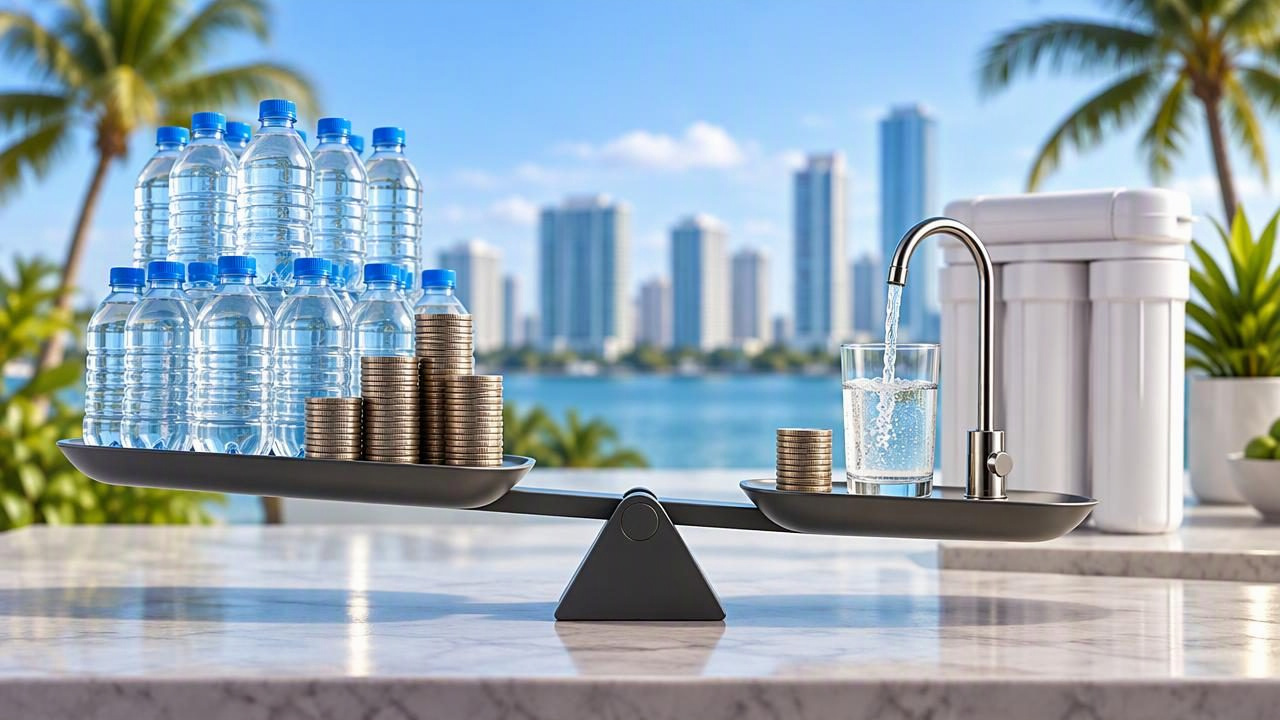
When you compare bottled water vs filtered water cost, the price on a case of water or a filter cartridge is only part of the picture. How much you drink, whether you buy single-use bottles or water-cooler jugs, and what kind of filtration your water needs all affect the total. For South Florida households and businesses, a fair comparison also includes delivery, storage, filter changes, and the convenience of having drinking water available at home or work.
This guide explains how to estimate the costs, compare common options, and choose a system based on your water and budget. The example prices are for illustration, not local quotes: actual costs vary by retailer, provider, equipment, and water use.
Start with how much water you use
A useful comparison begins with gallons, not packages. A four-person household that uses about two gallons a day for drinking and cooking needs roughly 730 gallons a year. Your actual use may be higher if you fill reusable bottles, make coffee and ice with filtered water, or provide water for guests. An office should estimate daily use by staff and visitors, rather than assuming every employee drinks the same amount.
Next, identify what you currently buy. Single-use bottles, refillable five-gallon jugs, and water delivered to a cooler have different costs. Filtered water also varies: a faucet-mounted filter, refrigerator filter, under-sink reverse osmosis system, and whole-house system have different upfront and maintenance expenses. They are not interchangeable, and each is designed for particular needs.
Comparing bottled and filtered water costs
The table below shows a sample annual comparison for a household using 730 gallons. Bottled-water prices are examples only. The filtered-water range represents an illustrative annualized equipment and replacement-filter budget; installation, service, and water use can move the total up or down. Include costs that apply to your situation before making a decision.
| Option | Example cost basis | Estimated annual cost for 730 gallons |
|---|---|---|
| Single-use bottles | $0.30–$0.80 per 16.9-ounce bottle | About $2,270–$6,040 |
| Five-gallon delivery | $8–$12 per jug, before possible fees | About $1,170–$1,752 |
| Filtered water | Illustrative $250–$600 annualized system and filter budget | About $250–$600, plus water and any applicable service costs |
The single-bottle estimate converts the example bottle price into a per-gallon price, then multiplies it by annual use. Five-gallon delivery assumes about 146 jugs per year. Delivery minimums, deposits, cooler rental, fuel surcharges, and missed-delivery fees can change that total. If you already own a dispenser or buy discounted cases, your costs may be lower.
Filtered water is not automatically the cheapest option in every circumstance. A high-end system, frequent cartridge changes, or low water use can reduce savings. But when a household uses a lot of bottled water, replacing recurring purchases with properly maintained filtration can lower the ongoing cost and reduce packaging.
What to include in the real cost of bottled water
The shelf price is easy to see, but it is not the entire expense. Consider how bottles are purchased and used:
- Recurring purchases: Add up the price of every case or jug over a full year, including weeks when guests or family members use more than usual.
- Delivery and equipment: Check for delivery charges, cooler rental, deposits, minimum orders, and fees for missed or changed appointments.
- Time and storage: Shopping, carrying, and storing water take time and space. Heavy cases and large jugs can be inconvenient in homes with limited storage.
- Plastic and disposal: Recycling access varies, and not every container is recycled. Reusable bottles reduce packaging, but still need regular washing.
For a business, these tasks have an operating cost too. Staff time spent ordering, receiving, organizing, and restocking water is time not spent on other work. A bottleless cooler may reduce those tasks, although it still needs filters, cleaning, and service.
What filtered water costs—and what it can cover
A filtration system may have an upfront equipment and installation cost, followed by replacement filters and occasional service. To compare fairly, add the expected costs over the period you plan to use the system. For example, divide the equipment and installation expense across its expected service life, then add annual filters, maintenance, and any extra water use. Ask for written details about what is included and which parts need replacement.
Different systems address different concerns. A certified carbon filter can improve chlorine taste and odor, while reverse osmosis (RO) can reduce a broader range of dissolved substances when the system is designed and certified for them. A water softener targets hardness minerals that contribute to scale; it does not serve as a substitute for a drinking-water filter. A whole-house system treats water at the point it enters the home, while an under-sink unit typically treats water at one tap.
Look for independent certification claims that match the contaminant you want to reduce. NSF/ANSI standards cover different treatment capabilities, so a general label such as “water filter” is not enough to confirm performance against lead, PFAS, or another specific substance. Read the product performance data and follow its rated capacity and replacement schedule.
South Florida water: test first, then choose
Water quality can vary by utility, building, plumbing, and water source. Municipal water is treated and monitored, but water can pick up substances from a building’s plumbing after it leaves the treatment plant. Private wells have different testing responsibilities and may require additional analysis. Taste or smell alone cannot reliably identify every contaminant.
Start with your utility’s annual water quality report if you receive municipal water. If you have a specific concern—such as lead from older plumbing, sulfur odor, or PFAS—consider an appropriate test and review the results with a qualified water professional. Testing helps prevent paying for treatment you do not need and helps identify equipment with the right performance claims. In particular, do not assume a basic pitcher filter addresses every contaminant.
Hard water deserves a separate conversation. It can leave mineral scale on fixtures and appliances, but a drinking-water filter and a softener do different jobs. If scale is your primary concern, compare softening options and maintenance costs rather than judging the system by bottled-water savings alone.
How to calculate your break-even point
Use a simple annual comparison based on your own receipts and expected filter costs:
- Estimate annual gallons used for drinking and cooking.
- Calculate what you spend on cases or delivery, including recurring fees and the cost of a cooler if applicable.
- For filtration, add annualized equipment and installation costs, replacement filters, maintenance, and any service fees.
- Subtract the filtered-water estimate from the bottled-water estimate. The result is your estimated annual difference.
For instance, if a household spends $1,300 a year on delivered water and estimates that an appropriate filter system will cost $450 a year when equipment and maintenance are averaged out, the estimated difference is $850 annually. This is a planning example, not a promise of savings. The result changes if the family uses less water, chooses a more expensive system, or has unusually high delivery costs. A lease or lease-to-own plan should be compared using the full payment term and included maintenance, not just the monthly figure.
Questions to ask before switching
Before purchasing a system or changing a delivery plan, ask:
- What specific water concern do I want to address, and is it supported by a test or utility report?
- Which contaminants is this model independently certified to reduce?
- What is the full cost of installation, filters, maintenance, and service over several years?
- How often do filters need to be changed, and what happens if I miss a replacement?
- For a business, how many users will the system serve, and who is responsible for cleaning and maintenance?
These questions keep the decision grounded in performance and total cost rather than a low introductory price. They also make it easier to compare a filtration system with a bottled-water contract on equal terms.
Making the choice for your home or business
Bottled water can be practical for temporary needs or locations without a suitable connection for a filter. Filtered water may be more convenient for regular use and can offer meaningful savings when it replaces frequent bottle or jug purchases. The best option depends on your consumption, water test results, system requirements, and the time you are willing to spend managing supplies.
For many South Florida residents, the next step is straightforward: estimate annual use, review the water quality information available to you, and compare total costs over the same period. A qualified provider can help explain system options and maintenance, but you should still verify certifications and read the service terms. Blog Water News covers practical water topics to help readers make informed choices for their homes and workplaces.