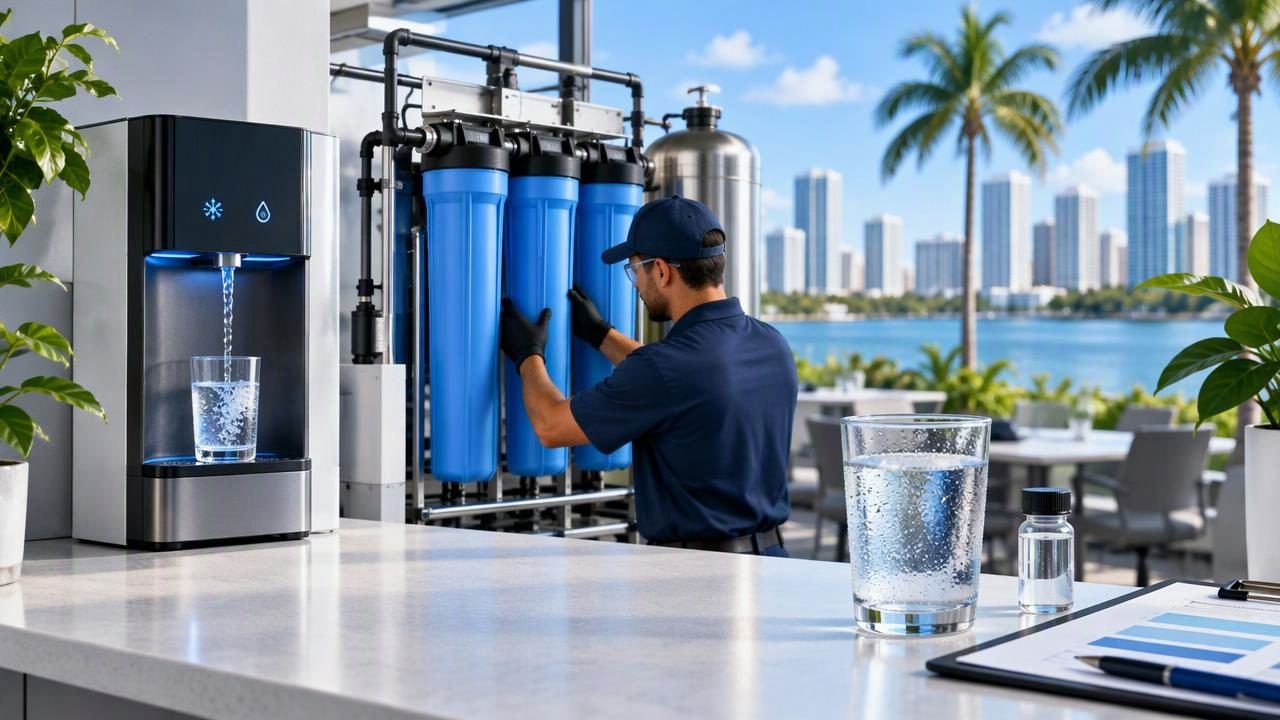
Water affects more than what customers taste in a glass. For a South Florida business, it can influence staff comfort, equipment performance, cleaning routines, and operating costs. A restaurant may need dependable water for beverages and food preparation, while an office may want a convenient alternative to delivered bottles. A salon, clinic, or fitness studio may have different priorities again.
The right commercial water filtration solutions depend on the water entering your building, how your business uses it, and which concerns you want to address. Choosing a system without answering those questions can mean paying for unnecessary treatment—or missing a problem that matters. This guide explains how to assess your needs, compare common options, and plan for ongoing care.
Start with your water and your business needs
South Florida water conditions vary by municipality, building, plumbing, and source. Public water is treated, but treatment can leave a noticeable chlorine taste or odor. Hardness, sediment, and mineral content can also affect fixtures and equipment. In some locations, private wells or aging plumbing introduce additional questions that require water testing.
Before comparing products, list where water is used and what you want to improve. Consider drinking and cooking, ice production, coffee and tea, food preparation, handwashing, laundry, or equipment that uses heated water. Ask staff which issues they notice: unpleasant taste, scale on faucets, spots on glassware, or frequent filter-related problems.
Then identify the business outcome you care about most. It might be better-tasting drinking water, fewer scale-related service calls, easier access to water for employees, or less handling and storage of plastic bottles. A clear goal helps narrow the system type and prevents a sales conversation from becoming a one-size-fits-all recommendation.
Test before selecting a treatment system
A water test can provide a starting point for deciding what treatment is appropriate. The right test depends on your source and concerns. A basic assessment may look at hardness, chlorine, pH, and sediment, while a more targeted laboratory analysis may be appropriate for concerns such as lead, PFAS, or other contaminants. Not every test measures every substance, so confirm what the results actually cover.
For businesses on municipal water, review the local utility’s water quality report, but remember that it describes water at the system level. It may not tell you about conditions inside your building, including plumbing-related lead risks or changes after water sits in pipes. A qualified water professional can help determine whether testing at a tap, at the point of entry, or at another location makes sense.
Use results to match treatment to a specific issue. Filtration is not a universal process: a carbon filter, softener, and reverse osmosis membrane perform different jobs. Avoid assuming that a product removes a contaminant unless its certification and documentation support that claim.
Compare common commercial water filtration solutions
Systems may treat water at a single tap or dispenser, at the equipment that needs protection, or where water enters the building. These approaches are often called point-of-use and point-of-entry treatment. The best fit depends on whether the concern affects drinking water only or multiple outlets and appliances.
| System type | Common purpose | Questions to ask |
|---|---|---|
| Activated carbon filtration | Can reduce chlorine taste and odor, depending on the filter and certification. | Which substances is the specific model tested or certified to reduce? |
| Reverse osmosis (RO) | Provides highly treated water at selected drinking-water points; may reduce a range of dissolved substances when properly certified. | What is the water output, reject-water rate, and maintenance requirement? |
| Water softening | Reduces hardness minerals that contribute to scale. | Does the building need softening, and where should the system be installed? |
| Sediment filtration | Captures particles such as sand or rust before they reach downstream equipment. | How quickly could the filter load, and how will it be monitored? |
| Bottleless water cooler | Filters a connection to the building’s water supply for convenient drinking water. | How many users will it serve, and who handles sanitation and filter changes? |
These categories can be combined, but more treatment is not automatically better. For example, a business may need carbon filtration at a drinking station but not a whole-building RO system. A softener may help manage hardness, while a drinking-water filter addresses taste. A professional assessment should explain why each stage is included.
Choose by application, not by the word “commercial”
Offices and customer-facing spaces
Offices often benefit from convenient filtered water at a shared station. A bottleless cooler can reduce deliveries, storage needs, and the lifting of heavy containers. Estimate daily use and peak demand before choosing capacity. A small unit may be adequate for a team of ten but frustrating in a busy workplace with visitors and multiple shifts.
Consider placement, access to a water line and drain if required, power needs, and routine sanitation. Include filter replacement and servicing in the plan. Bottleless equipment still depends on filters and hygienic handling; it is not a maintenance-free appliance.
Restaurants, cafés, and hospitality
Restaurants may use water for drinking, ice, coffee, cooking, and dishwashing. Taste consistency can matter for beverages, while scale can affect espresso machines, steamers, ice makers, and other equipment. Map each application and check the equipment manufacturer’s water specifications. A treatment system that works for a drinking faucet may not provide enough flow or capacity for an ice machine.
Plan for access during service hours and ask how the system will be maintained without disrupting operations. Filter changes should be scheduled before performance drops, with a clear contact for urgent service.
Clinics, salons, and fitness facilities
These businesses may have distinct uses, from employee hydration to laundry or specialized equipment. Avoid assuming a general-purpose drinking-water filter meets a process or sanitation requirement. Confirm any applicable equipment instructions and local requirements with the appropriate professional or authority.
Compare the full operating cost
Purchase price is only one part of the cost. Compare installation, replacement filters, service visits, water use, electricity where applicable, and potential downtime. For a bottleless cooler, compare those expenses with bottled-water deliveries, bottle deposits, storage space, and staff time spent receiving or moving supplies.
For equipment affected by hard water, also consider the cost of descaling, repairs, and shortened component life. Do not assume treatment will eliminate every service issue: maintenance habits, water chemistry, and equipment design all matter. Request a written estimate that identifies included work, replacement intervals, warranty terms, and any exclusions.
A practical comparison can use annual costs rather than a single monthly payment:
- Filtration: installation or lease, filters, service, and any required sanitation.
- Bottled delivery: recurring water charges, delivery fees, containers, storage, and handling time.
- Equipment protection: current scale-related maintenance and the expected service plan after treatment.
Use your actual invoices and usage where possible. A busy location and a small office will not have the same break-even point.
Plan a realistic maintenance schedule
Filters need replacement according to the manufacturer’s guidance, which may be based on time, gallons, or both. High usage, sediment, and incoming water conditions can shorten service life. A clogged or expired filter may reduce flow and performance, so do not rely on taste alone to decide when it is due.
Keep a simple service record showing the system model, filter type, installation date, estimated capacity, and next replacement date. Assign responsibility to a staff member or service provider, and make sure new employees know how to report leaks, unusual taste, low flow, or equipment alarms.
Include cleaning and sanitation for dispensers where required. If the system treats water for a particular machine, follow that machine’s maintenance instructions as well. Routine service protects the investment and helps keep water quality consistent.
Questions to ask before you commit
- What specific water concern is this system designed to address?
- Can you show the product’s applicable third-party certifications and performance data?
- How was the recommended system sized for our flow rate and daily usage?
- What maintenance is required, how often, and what does it cost?
- Who responds if there is a leak, drop in flow, or service interruption?
- Does installation require plumbing changes, drainage, electrical work, or permits?
Ask for a clear explanation of limitations as well as benefits. A trustworthy recommendation should connect test results and business requirements to the proposed equipment, not rely on broad claims that one system solves every water problem.
Make water quality part of operations planning
The strongest approach is to treat water as an operating need, not an afterthought. Test when appropriate, identify the uses that matter, select treatment based on documented performance, and assign someone to track maintenance. Revisit the plan if your usage changes, you renovate, or water quality symptoms appear.
With a well-matched system, a business can make drinking water more convenient, address specific taste or hardness concerns, and manage equipment care with fewer surprises. For more South Florida water-quality guidance, Blog Water News offers practical information to help local businesses ask informed questions and compare their options.