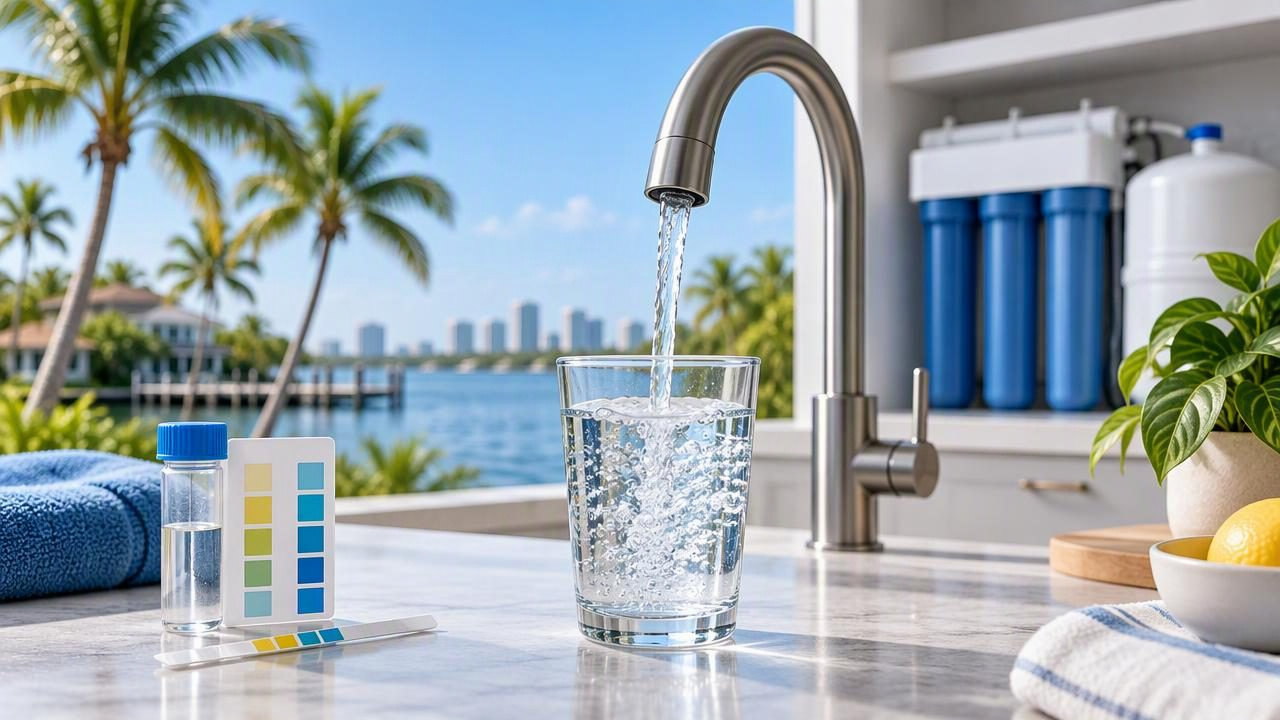
Water quality in Florida can vary from one neighborhood to the next—and even between homes on the same street. Your water may come from a municipal utility or a private well, travel through different plumbing, and contain minerals or disinfectants that affect its taste, smell, and performance. Knowing what is in your water helps you decide whether you need treatment, and which kind.
This Florida homeowner water quality guide explains how to check your source, understand common water concerns, select useful tests, and compare treatment options. The goal is not to assume your water is unsafe, but to make decisions based on reliable information and your household’s needs.
Start by identifying your water source
Most Florida homes receive water from a public utility. Utilities treat and monitor their supplies under federal and state drinking water requirements. If you are a customer, request the utility’s latest Consumer Confidence Report (CCR), also called an annual water quality report. It lists detected regulated contaminants, reported levels, and applicable standards. Many utilities publish the report online or provide a copy upon request.
A CCR describes water from the utility’s system; it does not test the plumbing inside your home. Conditions can change as water passes through service lines, faucets, and fixtures. Homes with private wells have a different responsibility: the owner must arrange testing and maintenance because a utility is not routinely monitoring that supply.
- Public water: Find your provider and review its current CCR, then consider testing at the tap if you have a specific concern.
- Private well: Test on a regular schedule and after flooding, repairs, or noticeable changes in taste, color, or odor.
- Uncertain source: Check your utility bill, ask your landlord or property manager, or contact the local health department.
Common water quality concerns in South Florida
Florida’s geology, water sources, treatment practices, and plumbing all influence what homeowners notice. A familiar issue is hard water: dissolved calcium and magnesium can leave scale on showerheads, faucets, glass, and heating elements. Hardness is generally an aesthetic or household-performance concern, not proof that water is unsafe. Scale can, however, reduce appliance efficiency and increase cleaning or maintenance needs.
Some utilities use chlorine or chloramine to disinfect water. These disinfectants help control microbes as water moves through the distribution system, but some residents notice a swimming-pool-like taste or smell. A properly selected and maintained carbon filter can reduce certain tastes and odors; the correct product depends on the disinfectant and the manufacturer’s tested performance.
Other concerns may include lead from older plumbing components, PFAS, iron, manganese, or sulfur-like odors. Their presence cannot be reliably confirmed by appearance, taste, or smell alone. A rotten-egg odor can have several causes, and a clear, pleasant-tasting sample is not proof that contaminants are absent. Testing is the way to investigate a specific concern.
Choose a water test that answers a real question
Before buying a filter or ordering a broad test panel, write down what prompted your concern. Is the issue scale, a disinfectant taste, a private well, an older home, or a notice from your utility? The answer helps determine which sample and analysis are appropriate. A basic hardness test will not reveal lead or PFAS, and a general screening kit may not provide the precision needed for a health-related decision.
For health concerns, use a certified laboratory or a testing service recommended by your local health department. Follow the sampling instructions closely: the container, faucet, flushing time, and timing can affect results. If you suspect lead, ask about sampling protocols designed to assess water after it has been sitting in household plumbing. For PFAS, use a lab with a validated method and follow its contamination-prevention instructions.
Private well owners should ask local health officials which tests are suitable for their area and household. Testing for bacteria and nitrate is especially important in many well-water programs, while additional testing may be appropriate based on local conditions, a nearby land use, or a change in the water. Keep copies of results so you can compare them over time.
How to read a water quality report
Look for the contaminant name, the level detected, the unit of measurement, and the relevant regulatory limit or health benchmark. Do not compare numbers unless the units match. A result reported in parts per billion is not directly interchangeable with one reported in parts per million. Also check whether a value is an average, a range, or a single sample.
A detection does not automatically mean a violation or an immediate health risk. At the same time, a result below a regulatory limit does not necessarily answer every household preference, such as reducing taste or odor. If a report is difficult to interpret, contact the utility, laboratory, or local health department and ask what the result means for your specific water source.
Match the treatment to the problem
Water treatment works best when it targets a verified issue. No single filter removes everything, and treatment claims apply only to contaminants named in a product’s testing or certification. Check the exact model—not just the brand—for third-party certification and the reduction claims relevant to your test results.
| Option | Common purpose | Important consideration |
|---|---|---|
| Activated carbon | Reducing certain chlorine tastes, odors, and specified compounds | Capacity and performance depend on the certified model and timely cartridge changes. |
| Reverse osmosis | Reducing many dissolved substances when the system is appropriately certified | Usually installed at a drinking-water tap; it produces reject water and needs filter and membrane maintenance. |
| Water softener | Reducing calcium and magnesium hardness | It is not a general-purpose contaminant filter or a substitute for disinfection. |
| Whole-house filtration | Treating selected issues at multiple household taps | Choose based on testing, flow needs, and the specific contaminant claim. |
For example, a household bothered by scale may benefit from a softener, while one focused on drinking-water taste may prefer a point-of-use carbon filter. A homeowner concerned about a specific dissolved contaminant may consider reverse osmosis if the chosen system is certified for that reduction. If results identify a health-related contaminant, consult the utility or a qualified water professional about immediate steps and appropriate treatment.
Point-of-use or whole-house treatment?
A point-of-use system treats water at one location, often the kitchen sink or refrigerator. It can be a practical choice when the concern is limited to drinking and cooking water. A whole-house system treats water entering the home and may address a verified issue affecting showers, laundry, or plumbing. It generally has higher installation and maintenance considerations, so avoid installing one simply because it sounds more comprehensive.
Consider how many fixtures need treatment, whether the issue affects all water uses, and what replacement parts cost. Check whether the system needs a dedicated faucet, drain connection, electricity, or space. Ask how treatment could affect water pressure and whether a plumber or trained installer should handle setup.
Protect your plumbing and appliances from hard water
If you see recurring white scale, measure hardness before choosing a solution. Hardness test strips can offer a quick indication, while a laboratory or water professional can provide a more precise result. Review appliance manuals for descaling and cleaning instructions, and remove buildup from aerators and showerheads as needed. Do not use an aggressive cleaner unless it is suitable for the fixture.
A softener can help reduce scale when hardness is confirmed, but compare operating costs, salt use, maintenance, and installation requirements. Some homes may need a different approach based on plumbing or local rules. Remember that softening changes mineral content; it does not remove every contaminant. If drinking-water quality is also a concern, test for that separately and select treatment accordingly.
Keep filters and treatment equipment maintained
A filter that is overdue for replacement may lose effectiveness or restrict flow. Follow the manufacturer’s schedule, but also pay attention to rated capacity, water usage, and any change in taste, odor, or pressure. Do not assume that a cartridge is working indefinitely because the water still looks clear.
- Record installation dates and replacement intervals for cartridges and membranes.
- Use replacement parts specified for the equipment and follow sanitation instructions.
- Maintain softener settings and replenish salt only as directed by the manufacturer.
- Retest when a treatment system is installed to address a measured contaminant, following professional or laboratory guidance.
Maintenance needs differ by system and source water. A household using well water with sediment may need a different schedule from a city-water home. Ask the installer what routine service includes, what is an extra cost, and how you can tell when maintenance is due.
Build a simple homeowner water plan
A manageable plan begins with information, not equipment. Identify your source, save the latest utility report or well-test results, and note any recurring issues. If you find an unusual result, verify it with an appropriate laboratory before making a major purchase. Then compare treatment options based on certified performance, installation, water use, replacement costs, and maintenance.
- Check your source: Confirm whether your home uses municipal water or a private well.
- Review available information: Read the CCR or collect current well-test results.
- Define the concern: Separate taste, odor, hardness, and health questions.
- Test selectively: Use a suitable method and a reliable lab for the concern at hand.
- Choose and maintain treatment: Match the certified claim to the result and keep a service record.
Water quality is specific to a source and a home, so there is no universal filter recommendation for every Florida household. A measured, targeted approach can help you avoid unnecessary equipment while addressing the issues that matter. For more practical water education, Blog Water News offers resources to help homeowners make informed decisions about testing and treatment.