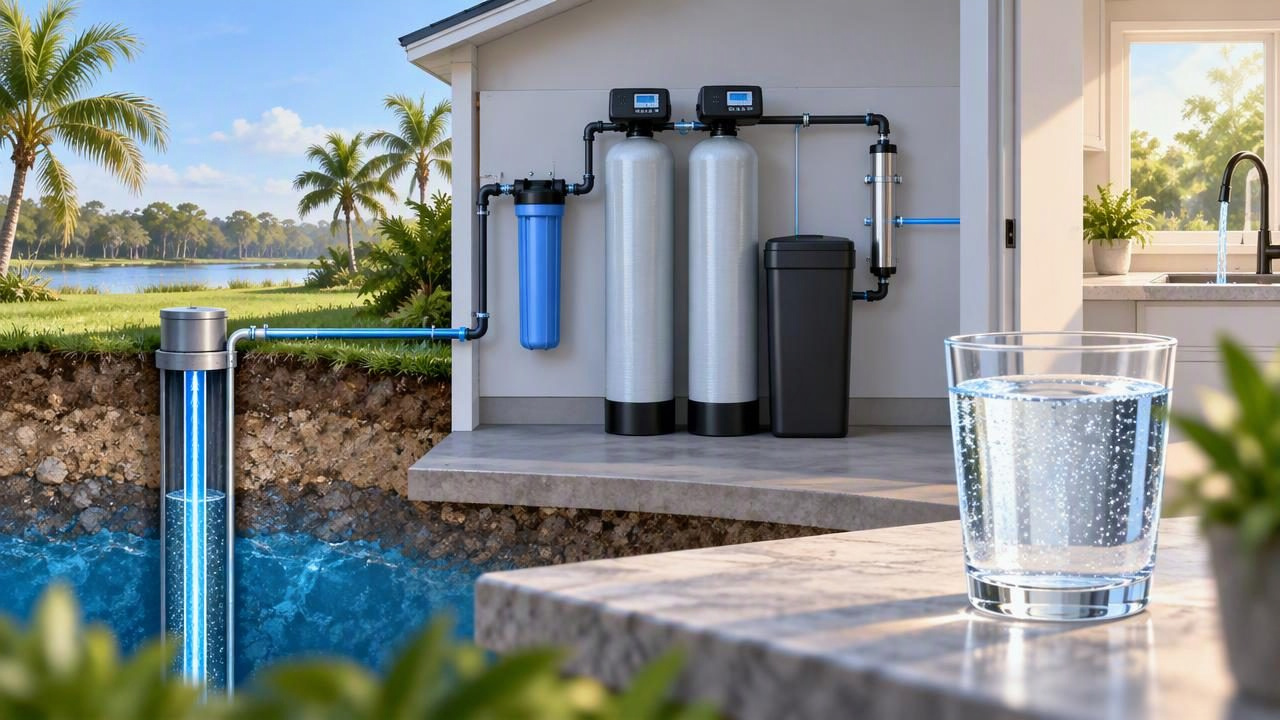
Private wells can provide a dependable water source for Florida homes, but well water quality can vary from one property to the next. Unlike water from a public utility, water from a private well is not routinely monitored by the utility before it reaches your tap. That makes testing and choosing the right treatment a homeowner’s responsibility.
The best Florida well water treatment options depend on what a test finds. A sediment filter may help with visible particles, while an ultraviolet system may be appropriate when testing identifies bacteria. No single filter removes every contaminant. Start with reliable test results, then select equipment designed for your water and household needs.
How Florida Well Water Differs from City Water
Well water is drawn from underground and may pick up naturally occurring minerals, organic material, or contaminants as it moves through soil and rock. Nearby land use, a well’s construction, heavy rain, flooding, and changes in groundwater conditions can also affect quality. Two neighboring homes may have different results, so a neighbor’s treatment setup is not a substitute for testing your own water.
Some well water concerns are easy to notice. A rotten-egg odor may be associated with hydrogen sulfide, and reddish stains can point to iron. Other issues, including certain bacteria, nitrate, lead, or PFAS, may not change the water’s taste, smell, or appearance. Clear water is not necessarily safe water.
Test Before Choosing a Treatment System
Testing helps identify what needs to be removed and avoids buying equipment that does not address the problem. Contact your county health department or a state-certified drinking water laboratory for guidance on sample collection and appropriate tests. Follow the lab’s instructions closely; an improperly collected sample can produce misleading results.
A useful test plan can include basic water characteristics and health-related contaminants. Depending on your location, well type, and circumstances, ask about:
- Bacteria: Total coliform and E. coli testing can help identify contamination concerns.
- Nitrate and nitrite: These are important to assess, especially for households with infants or pregnant family members.
- Metals and minerals: Iron, manganese, lead, and hardness can affect health, staining, taste, plumbing, or appliances.
- Water chemistry: pH, turbidity, and total dissolved solids can help guide treatment choices.
- Location-specific contaminants: Ask whether local conditions warrant testing for pesticides, volatile organic compounds, arsenic, or PFAS.
Test when you first move in, at least annually for bacteria and nitrate as recommended by public health guidance, and after events such as flooding, well repairs, or a noticeable change in taste, odor, or color. A laboratory or county health department can advise on the right schedule for your well. Keep a record of results and retest after installing treatment to confirm that it is working.
Common Florida Well Water Treatment Options
Different technologies solve different problems. A treatment professional should match system capacity and design to test results, peak water use, and the well’s flow rate. The following methods are common, but none should be selected on name alone.
| Treatment method | Often used for | Important consideration |
|---|---|---|
| Sediment filtration | Sand, silt, and visible particles | Does not disinfect water or remove dissolved contaminants |
| Water softening | Hardness minerals | Does not remove all contaminants or make unsafe water safe |
| Activated carbon | Some taste, odor, and chemical concerns | Media and system must be certified for the specific reduction claim |
| Reverse osmosis | Many dissolved substances at a drinking-water tap | Requires maintenance and produces a reject-water stream |
| Ultraviolet disinfection | Microorganisms, when properly designed and maintained | Water generally needs pretreatment for clarity; UV does not remove chemicals |
Sediment Filters
A sediment filter can capture particles such as sand and silt before they enter household plumbing or more sensitive treatment equipment. It may be a useful first stage when water is cloudy or contains visible debris. Filter pore size and replacement frequency matter: a clogged cartridge can reduce water pressure, while a sediment filter cannot remove dissolved minerals, bacteria, or most chemicals.
Water Softeners for Hard Water
Hard water contains calcium and magnesium that can leave scale on faucets, shower doors, water heaters, and appliances. A water softener uses ion exchange to reduce hardness and can help limit scale buildup. It is not a general-purpose purifier and should not be treated as a solution for bacteria, nitrate, or PFAS. Ask about salt use, wastewater, settings, and maintenance before installation.
Activated Carbon Filtration
Activated carbon can improve certain taste and odor issues and reduce specific chemicals when the product is certified and used according to its rated capacity. It may be installed at one faucet or as part of a larger system. Carbon is not a universal treatment, and exhausted media can stop performing as intended. Replace filters on schedule rather than waiting for the water to taste different.
Reverse Osmosis for Drinking Water
Reverse osmosis, or RO, pushes water through a semipermeable membrane and is commonly installed under a kitchen sink for drinking and cooking water. Depending on the system’s certification, it can reduce many dissolved substances. RO does not automatically address every contaminant, and it is not usually the only treatment needed for an entire well-water supply. Check the performance claims for the exact model and maintain prefilters, membranes, and postfilters as directed.
Ultraviolet Disinfection
UV treatment can inactivate certain microorganisms as water passes through a properly sized unit. It does not remove sediment, metals, or chemical contaminants. Cloudy water can interfere with UV performance, so filtration or other pretreatment may be needed. The lamp must be replaced on schedule, the sleeve kept clean, and the unit supplied with power for treatment to work reliably.
How to Choose the Right Combination
Use the lab report as the starting point, not a salesperson’s broad promise or a product label that says it removes contaminants generally. Look for independent certification to standards relevant to your concern, such as NSF/ANSI performance standards, and verify the exact reduction claim in the product documentation. Certification applies to specific models and claims, not every product made by a brand.
- Identify the concern. Separate health-related findings from aesthetic issues such as odor, staining, or scale.
- Choose treatment for that result. Confirm that the technology is designed and certified to reduce or address the contaminant found.
- Check system capacity. Match flow rate and household demand to the well and equipment.
- Plan for upkeep. Include filter changes, sanitation, salt, UV lamps, and follow-up testing in the ownership budget.
Some homes need more than one stage. For example, a tested system might use sediment pretreatment to protect other equipment, a softener for hardness, and a separate certified drinking-water filter at the kitchen tap. That example is not a prescription: actual results should determine the design.
Maintenance and Follow-Up Testing
Well water treatment requires ongoing attention. Replace cartridges and media according to the manufacturer’s instructions, sanitize equipment when recommended, and keep service records. Check for leaks, unusual pressure changes, alarms, and changes in water quality. A professional inspection can help identify worn components, incorrect settings, or a system that is no longer suited to current test results.
Retest treated water when appropriate to confirm performance, particularly after repairs, system changes, or a health-related result. A filter’s age alone does not prove that it is working, and a taste improvement does not confirm contaminant removal. If a test identifies a potential health hazard, contact your county health department or a qualified water professional promptly for guidance on safe water use and corrective steps.
Frequently Asked Questions
Is well water safe to drink in Florida?
It may be safe, but safety cannot be determined by appearance or by the fact that the water comes from a well. Testing is the reliable way to check for relevant contaminants. Private well owners should follow local public health guidance and keep up with regular testing.
Will a whole-house filter make well water safe?
Not necessarily. Whole-house filters vary in what they treat, and many target sediment, taste, or odor rather than every health-related contaminant. Choose equipment based on test results and documented performance claims.
What should I do if the water changes suddenly?
Stop relying on assumptions about the water and arrange appropriate testing. If flooding, well damage, or a concerning lab result is involved, seek advice from the county health department about precautions and next steps.
Make Well Water Decisions with Evidence
Florida well water treatment options range from simple sediment filtration to multi-stage systems that combine softening, carbon, RO, or UV treatment. The right choice begins with a certified laboratory test, follows with technology matched to the results, and includes a realistic maintenance plan. For more practical water-quality guidance, Blog Water News shares resources for South Florida homeowners and businesses.