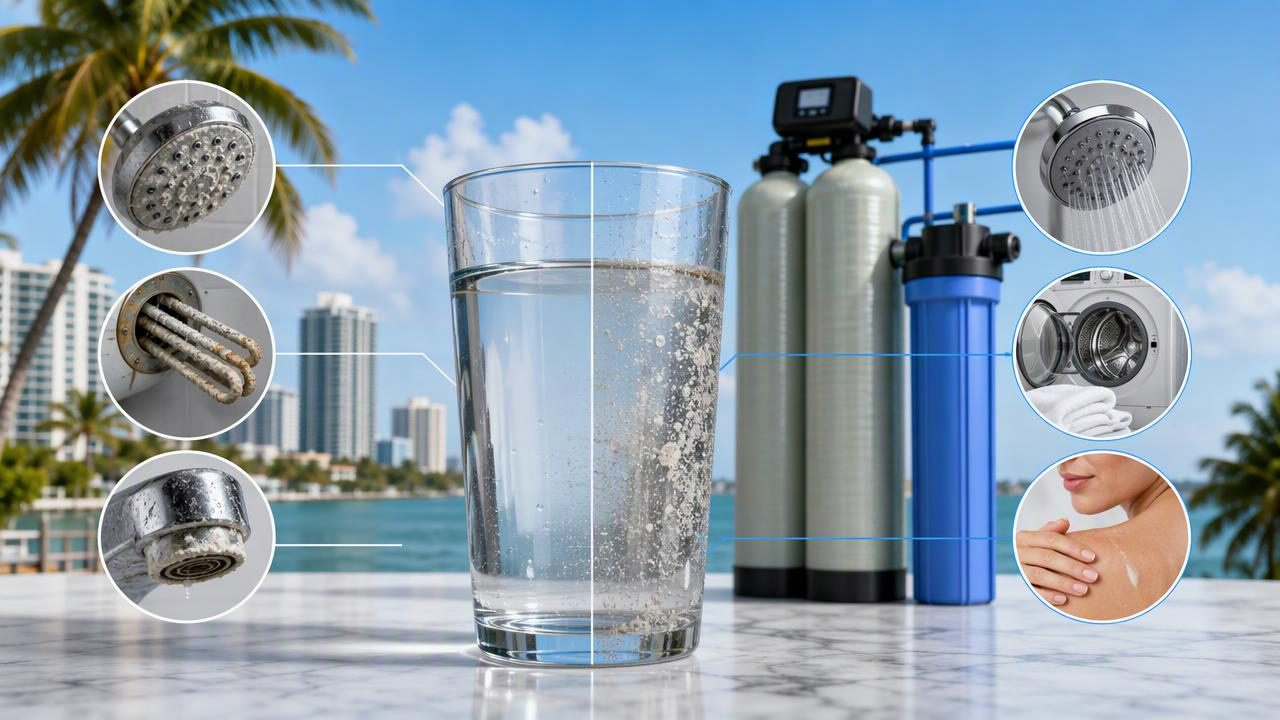
Hard water problems in South Florida are more common than many homeowners and business owners realize. If you have noticed white spots on glassware, crusty buildup around faucets, stiff laundry, dry skin after showering, or appliances that seem to fail too soon, mineral-heavy water may be a contributing factor.
South Florida water quality can vary by neighborhood, water source, plumbing age, and whether a property uses municipal water or a private well. While treated city water is generally managed for safety standards, it can still contain dissolved minerals that create scale in pipes and equipment. Well water may introduce additional concerns, including sulfur odors, iron staining, sediment, and varying hardness levels.
Understanding what hard water is, what it does to a property, and which treatment methods address it can help you make better decisions about water testing, filtration, maintenance, and long-term household costs.
What Is Hard Water?
Hard water contains elevated levels of dissolved minerals, primarily calcium and magnesium. These minerals occur naturally when water travels through soil and rock before entering groundwater supplies, wells, or municipal treatment systems.
Water hardness is commonly measured in grains per gallon (GPG) or milligrams per liter (mg/L). The higher the mineral concentration, the more likely you are to experience scale buildup and other hard water symptoms.
| Hardness Level | Grains Per Gallon | What You May Notice |
|---|---|---|
| Soft | 0–3.5 GPG | Little to no mineral scale |
| Moderately hard | 3.6–7 GPG | Some spotting and reduced soap lather |
| Hard | 7.1–10.5 GPG | Visible deposits, appliance inefficiency, dry-feeling skin |
| Very hard | More than 10.5 GPG | Frequent scale, plumbing issues, and higher maintenance needs |
Hard water is not automatically unsafe to drink. In fact, calcium and magnesium are naturally occurring minerals. However, the practical effects of hard water on plumbing, appliances, cleaning, and comfort can be significant.
Common Signs of Hard Water Problems in South Florida
Because South Florida homes often use tankless water heaters, dishwashers, ice makers, coffee machines, pool equipment, and irrigation systems, hard water can create problems throughout a property. Watch for these common signs:
- White or cloudy spots on dishes, shower doors, sinks, and glassware.
- Chalky buildup around faucets, showerheads, and toilet bowls.
- Reduced water pressure caused by mineral scale inside plumbing fixtures.
- Soap that does not lather well and residue left on skin or hair.
- Stiff or dull laundry, even when using quality detergent.
- Shorter appliance life for water heaters, washing machines, dishwashers, and ice makers.
- Higher energy use when scale makes water-heating equipment less efficient.
- Frequent plumbing repairs involving clogged aerators, valves, or fixtures.
In coastal communities, homeowners may also see confusion between hard-water scale and salt-related corrosion. These are different issues. Scale is usually a hard, whitish mineral deposit, while corrosion often appears as rust, pitting, greenish discoloration on copper, or metal deterioration. A professional water test can help identify what is actually affecting your system.
How Hard Water Affects Plumbing and Appliances
One of the most expensive hard water problems in South Florida is mineral scale inside pipes and water-using equipment. As hard water is heated or evaporates, calcium and magnesium can settle out and form deposits. Over time, that scale narrows water pathways and forces equipment to work harder.
Water Heaters and Tankless Systems
Scale acts like insulation inside a conventional water heater or tankless heat exchanger. The system may need more energy to heat the same amount of water, and internal components can experience more strain. Tankless units are especially sensitive because their narrow internal passages can collect deposits quickly when hardness is high.
Dishwashers, Ice Makers, and Coffee Equipment
Small appliances often reveal water hardness early. Cloudy glasses, slow ice production, mineral deposits in coffee makers, and repeated dishwasher cleaning cycles may all point to hard water. In offices, break rooms with bottleless water coolers, ice machines, and coffee stations can benefit from treatment selected for the water source and equipment requirements.
Faucets, Showerheads, and Plumbing Fixtures
Scale can clog aerators and showerhead nozzles, making a fixture appear weak even when the main water pressure is normal. Regular cleaning helps temporarily, but recurring buildup usually means the mineral content should be evaluated at the source.
Hard Water, Skin, Hair, and Laundry
Hard water does not affect everyone in the same way, but many people notice that soap and shampoo feel harder to rinse away. Minerals can react with soap to create a residue sometimes called soap scum. This may leave skin feeling dry, hair feeling dull, and shower surfaces looking filmy.
Laundry can also suffer. Mineral deposits may keep detergent from working as effectively, leaving fabrics rough, faded, or less absorbent. Families may use more detergent, fabric softener, cleaning products, and descaling solutions than necessary without realizing that water hardness is the underlying issue.
When cleaning products seem to stop working, the water itself may be part of the cleaning challenge.
Hard Water vs. Other South Florida Water Concerns
Hardness is only one part of water quality. A complete water test can identify conditions that a basic hardness strip cannot. Depending on the area and water source, testing may evaluate:
- Chlorine or chloramine: Disinfectants often used in municipal water treatment that can affect taste, odor, and sensitive skin.
- Lead: A concern in certain older plumbing components, fixtures, or service lines.
- PFAS: A group of persistent chemicals that may require specialized testing and treatment planning.
- Sulfur: Often associated with a rotten-egg odor, especially in some well-water systems.
- Iron and manganese: Minerals that may cause orange, brown, or black staining.
- Sediment: Fine particles that can clog filters and affect water clarity.
A water softener is designed primarily to reduce hardness minerals. It is not automatically the right solution for chlorine, lead, PFAS, bacteria, sulfur, or every taste-and-odor issue. This distinction matters when comparing whole-house filtration, carbon filtration, reverse osmosis, ultraviolet disinfection, and softening equipment.
Which Water Treatment Option Helps?
The best solution depends on what testing finds and where you want treated water. Many properties use more than one method because different technologies solve different problems.
| Method | Best For | Important Limitation |
|---|---|---|
| Water softener | Calcium and magnesium hardness; scale reduction | Does not remove every contaminant or improve all tastes |
| Carbon filtration | Chlorine, many odors, and improved taste | Does not reliably soften hard water |
| Reverse osmosis | Drinking water with reduced dissolved solids and select contaminants | Usually installed at a point of use, not for every fixture |
| Sediment filtration | Sand, rust particles, and visible debris | Does not remove dissolved minerals |
| UV treatment | Microbiological control in appropriate private-water applications | Does not remove hardness, chemicals, or sediment |
For many homes, a practical setup may include whole-house sediment and carbon filtration, a softener where hardness is confirmed, and a reverse osmosis system at the kitchen sink for drinking and cooking water. A small business may instead prioritize equipment protection, better-tasting employee drinking water, and fewer recurring bottled-water deliveries.
Why Water Testing Should Come First
Buying equipment before testing can lead to unnecessary expense or incomplete treatment. A water test provides a baseline, helping you understand whether you are dealing with hardness alone or a combination of issues.
For the most useful results, test water at the point where it enters the home and, when appropriate, at a drinking-water faucet. If you use well water, test periodically and after flooding, plumbing changes, unusual odors, discoloration, or changes in taste.
- Identify visible symptoms, such as scale, odors, stains, or cloudy water.
- Determine whether your water comes from a utility or a private well.
- Request testing that matches your concerns rather than testing only for hardness.
- Review the results alongside your plumbing, appliance, and household needs.
- Select treatment equipment with a clear maintenance plan.
Maintenance Matters for Long-Term Results
Even the right filtration or softening system requires maintenance. Ignoring filters, resin care, sanitization, or scheduled service can reduce performance and allow scale or taste concerns to return.
- Replace sediment and carbon filters according to the manufacturer’s schedule and local water conditions.
- Keep water softener salt at an appropriate level if using a salt-based system.
- Schedule tankless water heater flushing when recommended for your hardness level.
- Clean faucet aerators and showerheads when flow declines.
- Change reverse osmosis prefilters and postfilters on schedule; replace membranes as needed.
- Retest water when conditions change or after major plumbing work.
For homeowners, consistent maintenance can help protect large investments such as water heaters and kitchen appliances. For offices and small businesses, it can reduce downtime, improve employee hydration, and make operating costs more predictable.
Practical Steps to Reduce Hard Water Damage Now
You do not need to wait for a major plumbing failure to address hard water. Start with simple actions: inspect faucets and showerheads for mineral deposits, clean fixtures with manufacturer-approved descaling products, check appliance manuals for water-quality recommendations, and track how often you buy cleaning products or bottled water.
If hard water symptoms are persistent, arrange a water quality test and compare treatment options based on the results. The goal is not simply to install more equipment; it is to use the right equipment for your actual water conditions.
For more practical guidance on South Florida water quality, appliance protection, and healthy hydration, Blog Water News offers educational resources designed to help property owners make informed water decisions.