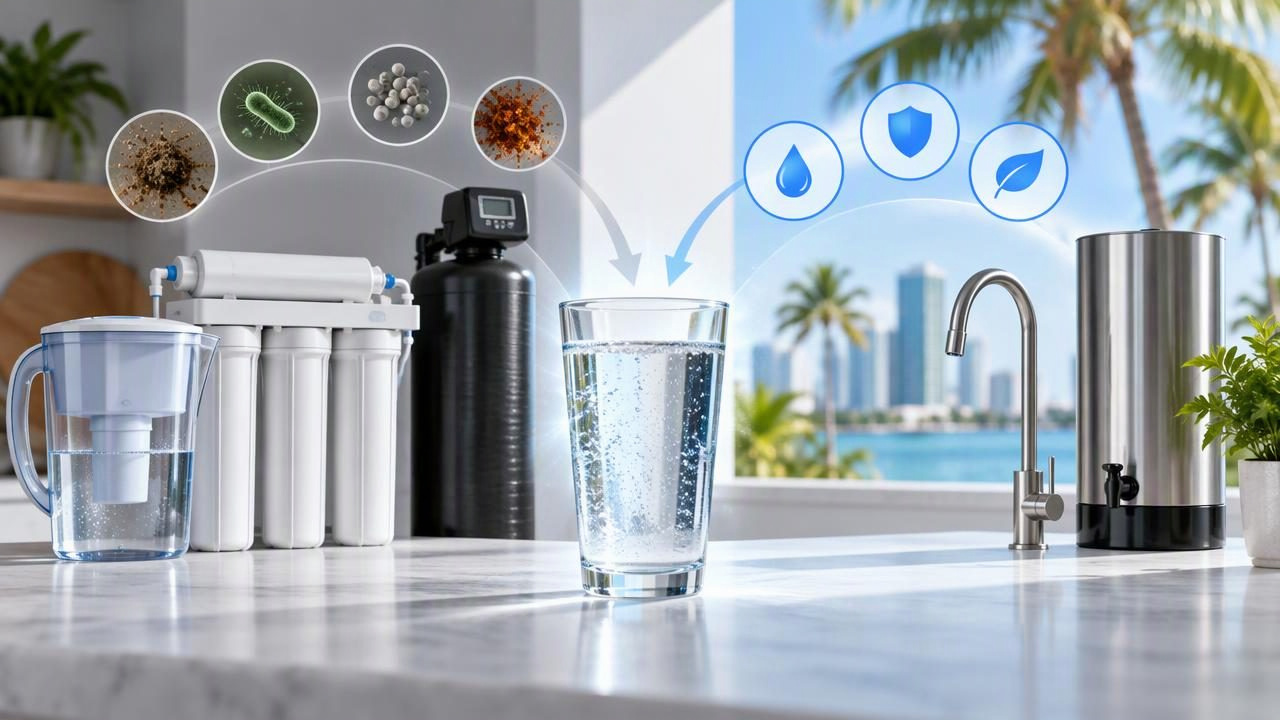
Choosing the best water purification system for home use starts with a simple question: What do you want to remove from your water? A system that improves taste may not address hardness, and one that softens water may not reduce contaminants such as lead or PFAS. The right choice depends on your water source, test results, household needs, and willingness to maintain the equipment.
For South Florida homeowners, local conditions matter. Municipal water is treated and monitored, but its taste and mineral content can vary by location. Private wells have different testing responsibilities and may contain issues such as sulfur odors or naturally occurring minerals. Plumbing can also affect water quality after treatment. Rather than buying a system based on a broad claim, use a step-by-step approach to match treatment to your water.
Start With a Water Quality Test
Before comparing equipment, find out what is in your water and what concerns you want to address. If you receive municipal water, review the provider’s Consumer Confidence Report. It can show detected substances and how the utility’s results compare with regulatory standards. However, the report reflects water sampled in the distribution system, not necessarily water from your own tap.
A home test can help identify changes that occur in your plumbing or at your property. Testing is especially important if you use a private well, notice a persistent odor or discoloration, have older plumbing, or are considering a system for a specific contaminant. A certified laboratory can provide more reliable results than a basic screening kit for many substances.
Depending on your water source and concerns, ask about testing for:
- Hardness: Dissolved calcium and magnesium that can leave scale on fixtures and appliances.
- Chlorine: A disinfectant used in many municipal systems that can affect taste and smell.
- Lead: A potential concern from certain plumbing materials, fixtures, or service lines.
- PFAS: A group of persistent chemicals that require appropriate testing and treatment.
- Sulfur compounds: Possible causes of a rotten-egg odor, particularly in some well supplies.
Testing helps you avoid paying for treatment you do not need. It also makes it easier to check whether a system is designed for the contaminants you want to reduce.
Compare Common Home Water Treatment Options
Water treatment systems work in different ways. Some target water at a single faucet, while others treat water entering the home. The best fit may be one system or a combination, but each part should have a clear purpose.
| System | Typical purpose | What to consider |
|---|---|---|
| Activated carbon filter | Improves taste and odor; can reduce chlorine and certain other substances. | Performance depends on filter design, certification, and timely replacement. |
| Reverse osmosis (RO) | Provides point-of-use treatment for drinking and cooking water; may reduce a range of dissolved substances. | Check certified performance, water pressure, storage needs, and wastewater. |
| Water softener | Reduces hardness minerals to help limit scale and soap residue. | It is not a general-purpose purifier and does not remove every contaminant. |
| Whole-house filtration | Treats water at the point it enters the home for selected concerns. | Choose media based on test results, flow rate, and household demand. |
| Ultraviolet treatment | Inactivates certain microorganisms in properly designed systems. | It does not remove chemicals, minerals, or particles and needs routine service. |
Reverse Osmosis, Carbon, or Whole-House Filtration?
Reverse osmosis for drinking water
An under-sink RO system forces water through a semipermeable membrane and may include sediment and carbon prefilters. It is a popular choice for drinking and cooking because a properly selected, maintained unit can reduce multiple dissolved substances. However, “reverse osmosis” alone is not proof that a particular model reduces a specific contaminant. Check the product’s performance data and relevant independent certifications, such as NSF/ANSI standards, for the exact reduction claims.
RO systems generally produce some wastewater, and output depends on water pressure, temperature, and system design. They also require filter and membrane changes. Some models add minerals back to the water, but remineralization is a preference, not a substitute for checking the system’s certified performance.
Carbon filtration for taste and odor
Carbon filters can be a practical choice when the main goal is reducing chlorine taste or odor. They are available in pitchers, faucet attachments, refrigerator filters, and whole-house configurations. Different carbon products have different capabilities, so do not assume a basic taste-and-odor filter will address lead, PFAS, or every other concern.
Whole-house systems and softeners
A whole-house filter can treat water used for bathing, laundry, and appliances as well as water used for drinking. That can make sense when testing identifies a concern throughout the home, but it may not be the most economical way to provide highly refined drinking water. A point-of-use filter at the kitchen tap may be more targeted.
If scale buildup is the primary problem, a softener may help protect plumbing and appliances and reduce spots on dishes. Hard water can make soap less effective and leave deposits on faucets, showerheads, water heaters, and other equipment. Yet a softener is designed for hardness—not for disinfecting water or addressing every chemical. Homes with both hardness and drinking-water concerns may need separate, appropriately selected systems.
How to Match a System to Your Household
Think about how water is used in your home, not only what comes out of the kitchen faucet. A family that cooks frequently may value convenient filtered water at the sink. A larger household may need a system with sufficient daily output and storage. If scale is shortening the life of appliances, hardness treatment may be a higher priority than a drinking-water filter.
Consider these questions before you buy:
- Is your supply municipal water or a private well?
- What do a recent report or test results show?
- Which concerns are most important: taste, odor, scale, or a named contaminant?
- Do you want treatment at one faucet or throughout the house?
- Can the system meet your household’s water use and fit the available space?
- What are the installation, replacement-filter, service, and water-use costs?
For renters or households seeking a simple taste improvement, a certified pitcher or faucet filter may be sufficient. Homeowners addressing a confirmed contaminant may need a more specific, professionally installed solution. For well water, the treatment plan should be based on a suitable test and may require several stages.
Look Beyond the Purchase Price
The upfront cost is only part of a system’s lifetime expense. Compare the initial equipment and installation price with replacement filters, membranes, service visits, electricity where applicable, and water use. Ask how often each part needs attention and whether replacements are easy to obtain. A lower-cost unit can become less economical if its filters are expensive or difficult to change.
Also compare the value of treating only drinking water with treating every tap. A whole-house setup may be helpful for a home-wide issue, while a point-of-use unit can avoid unnecessary treatment elsewhere. Get a written estimate that specifies equipment, installation, maintenance expectations, and warranty terms. Avoid choosing a system solely because a salesperson claims it removes “everything”; request documentation for the exact model and substances.
Maintenance Keeps Treatment Working
Every filter has a service life. When a cartridge is overdue, water flow may drop, taste may change, or the filter may no longer perform as intended. Use the manufacturer’s schedule, which may be based on time, gallons treated, or both. High sediment levels or unusually heavy use can mean more frequent replacement.
- Replace cartridges and membranes using the model’s instructions.
- Sanitize storage tanks and system components when the manufacturer recommends it.
- Check for leaks, unusual noises, reduced flow, or a sudden change in taste.
- Keep a simple log of installation dates, filter changes, and service.
- Retest water when appropriate, particularly after changes to a well or plumbing.
Do not wait for an unpleasant taste to appear before servicing a filter. Taste is not a dependable measure of safety, and many substances cannot be seen, smelled, or tasted.
Make a Confident Choice
The best water purification system for home use is the one that addresses a documented need, fits your water source, and can be maintained consistently. Start with a water report or test, identify your priorities, and compare certified performance rather than broad marketing language. Keep in mind that a softener, carbon filter, RO unit, and whole-house system solve different problems; one is not automatically a replacement for another.
For South Florida homeowners, understanding local water quality and household plumbing is a useful first step toward better-tasting water and more informed decisions about scale and filtration. The editors at Blog Water News encourage readers to use test results, product documentation, and a realistic maintenance plan when evaluating treatment options.