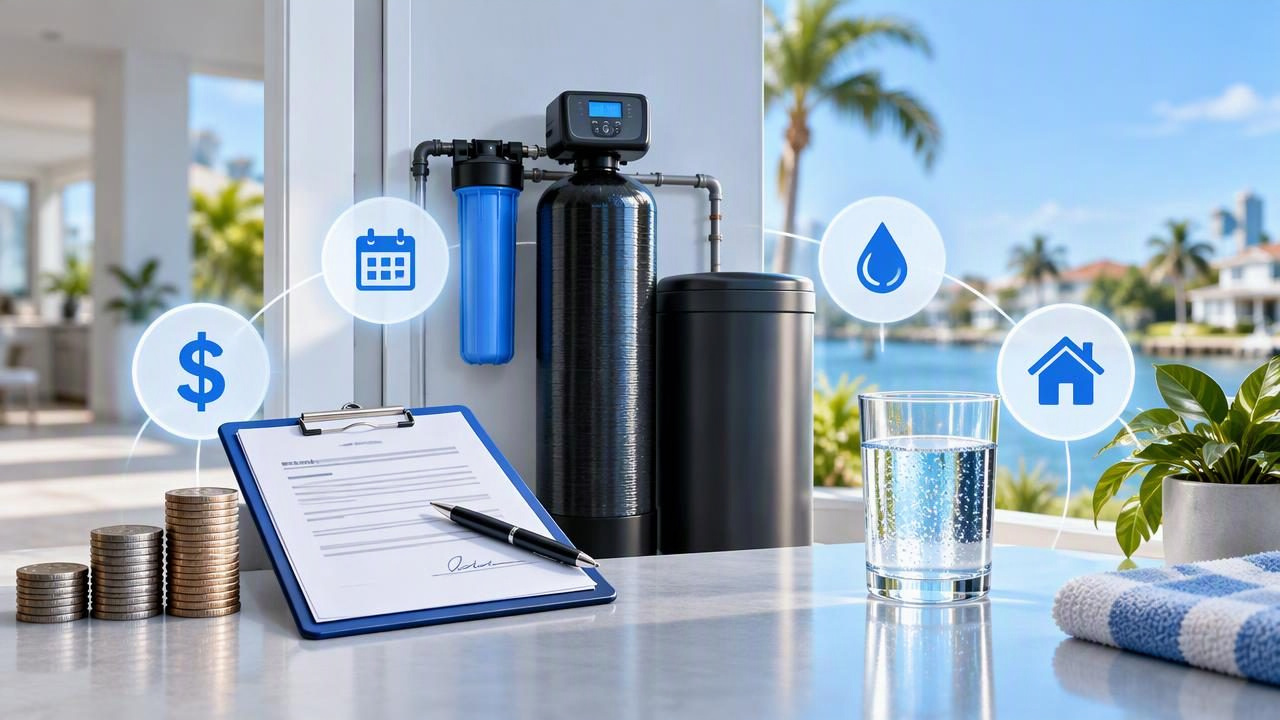
A lease-to-own water filtration system can make home water treatment easier to budget for. Instead of paying the full equipment cost upfront, you make scheduled payments under an agreement that may include installation, service, or filter changes. At the end of the term, you may own the system, depending on the contract.
That arrangement can be appealing to South Florida households weighing concerns such as chlorine taste, hard water, or specific contaminants against a large initial expense. But monthly price alone does not show whether a plan is a good fit. The treatment technology, maintenance terms, total cost, and ownership conditions all matter. Here is how to compare options carefully.
What Does Lease-to-Own Mean for Water Filtration?
With a lease-to-own plan, a provider installs a filtration or purification system and you pay a set amount over an agreed period. The contract should explain what happens when payments end. Some agreements transfer ownership automatically after the final payment; others may require a buyout, renewal, or additional step. Confirm the details in writing rather than assuming that “lease-to-own” means the same thing everywhere.
Plans can cover different equipment, including point-of-use reverse osmosis (RO) systems, whole-house filters, water softeners, or bottleless dispensers. A monthly payment might also include routine maintenance or replacement filters. Those services are not guaranteed inclusions, so compare the actual contract rather than relying on the plan name.
Why Homeowners Consider a Monthly Payment
Purchasing a complete system can require a sizable upfront payment, particularly when treatment involves multiple stages or installation changes. Spreading payments over time can make the expense more predictable and leave savings available for other home needs. A plan that includes preventive maintenance may also help households avoid forgetting filter changes or facing an unexpected service bill.
Convenience is only one factor. A treatment system should address a verified water concern, not simply add equipment. For example, a carbon filter may improve chlorine taste and odor, while a softener targets hardness minerals. RO may be appropriate for certain dissolved substances at a drinking-water tap. One device does not automatically solve every water issue.
Lease-to-Own vs. Leasing vs. Buying
These arrangements can sound similar but have different financial outcomes. A lease may provide use of the equipment for a set period without transferring ownership. A lease-to-own agreement generally offers a path to ownership, subject to its terms. Buying outright means you own the system immediately, while paying separately for installation, supplies, and service unless they are included.
| Option | What to compare | Potential fit |
|---|---|---|
| Lease-to-own | Total payments, included service, and transfer-of-ownership terms | Households seeking predictable payments and a defined ownership path |
| Rental or lease | Ongoing fees, cancellation rules, and who owns the equipment | People who prioritize service or flexibility over ownership |
| Outright purchase | Purchase price plus installation, filter costs, and repair coverage | People able to pay upfront and manage future maintenance |
To compare fairly, calculate the total amount you would pay over the full term, including any setup charges, taxes, service fees, or end-of-term purchase costs. Then compare that figure with buying a similar system and paying for its expected maintenance. The lowest monthly payment is not necessarily the lowest overall cost.
Estimate the Total Cost, Not Just the Monthly Price
For illustration, a plan advertised at $59 per month for 60 months would add up to $3,540 before any charges not included in the quoted payment. This example is not a market average or a promise about what a particular plan covers. Ask for a written breakdown and confirm whether the amount changes during the term.
Also consider the cost of filters and service after the agreement ends. A system that becomes yours may still need replacement cartridges, sanitation, or occasional repairs. Find out whether the provider uses proprietary parts, how much routine upkeep typically costs, and whether you can choose another qualified service company later.
Check Whether the System Matches Your Water
South Florida water conditions can differ by city, utility, building, and plumbing. Start with your utility’s annual water quality report, then arrange testing when you have a specific concern or use a private well. Testing can help identify issues such as hardness, chlorine, sulfur odor, lead, or PFAS. A report on source water does not always describe water after it passes through a building’s plumbing.
Match treatment to the test results and the intended use. Whole-house treatment serves multiple taps, while a point-of-use system treats water at one faucet. A softener reduces hardness minerals but does not serve as a general contaminant filter. RO systems can reduce a range of dissolved substances when the unit is designed and certified for them, but they do not automatically address every contaminant. Look for independent certification and verify the specific reduction claims for the model.
Questions to Ask Before Signing
Request the contract and system specifications before agreeing to a plan. These questions can reveal important differences between offers:
- What exact equipment, model, and treatment stages will be installed?
- Which water concerns is the system designed and independently certified to reduce?
- Does the monthly payment include installation, filter replacement, labor, and preventive maintenance?
- How often are filters changed, and are there limits on service visits?
- What is the total payment over the full term, including fees and any required final payment?
- When does ownership transfer, and what happens if I move, cancel, or miss a payment?
- Who handles repairs, and what is excluded from the warranty or service plan?
- Will installation require plumbing, electrical, or cabinet changes, and who pays for them?
For a home sale or move, ask whether the agreement can be transferred to a new homeowner and whether approval or fees are required. Keep copies of the contract, test results, installation details, and maintenance records.
Maintenance Still Matters
A payment plan cannot make a filter last indefinitely. Cartridge life depends on the system, water conditions, and the amount of water used. Follow the manufacturer’s schedule, and ask how the provider tracks due dates if maintenance is included. Delayed replacement can reduce performance, while an overdue RO membrane or neglected softener may need more than a routine filter change.
Ask for a clear service record after each visit, including the parts replaced and any measured changes. If you notice a sudden taste change, a leak, reduced flow, or an unusual odor, contact the service provider rather than waiting for the next scheduled visit. Maintenance is part of the system’s long-term cost, whether it is bundled into monthly payments or billed separately.
When a Lease-to-Own Plan May Not Be Right
A plan may be a poor fit if the agreement is unclear, the system is not matched to your water, or the full-term cost is much higher than comparable ownership options without a service benefit you value. It may also be unsuitable if you expect to move soon and cannot transfer or end the agreement affordably. Households comfortable managing maintenance may prefer an outright purchase, while renters should confirm that the property owner approves installation.
Be cautious of high-pressure sales tactics, vague performance promises, or claims that a system removes “everything.” Ask for model-specific certification, a complete price, and time to review the contract. If a salesperson recommends treatment before testing or explaining the water concern, seek another opinion.
Make a Confident Decision
A lease-to-own water filtration system can offer manageable payments and a practical route to ownership, particularly when maintenance is clearly included. Its value depends on more than affordability: the system must suit your water, the contract must spell out service and ownership, and the total cost should compare well with alternatives.
Start with a water report or appropriate testing, identify the problem you want to address, and compare written proposals side by side. For more homeowner guidance on South Florida water, explore the resources from Blog Water News.