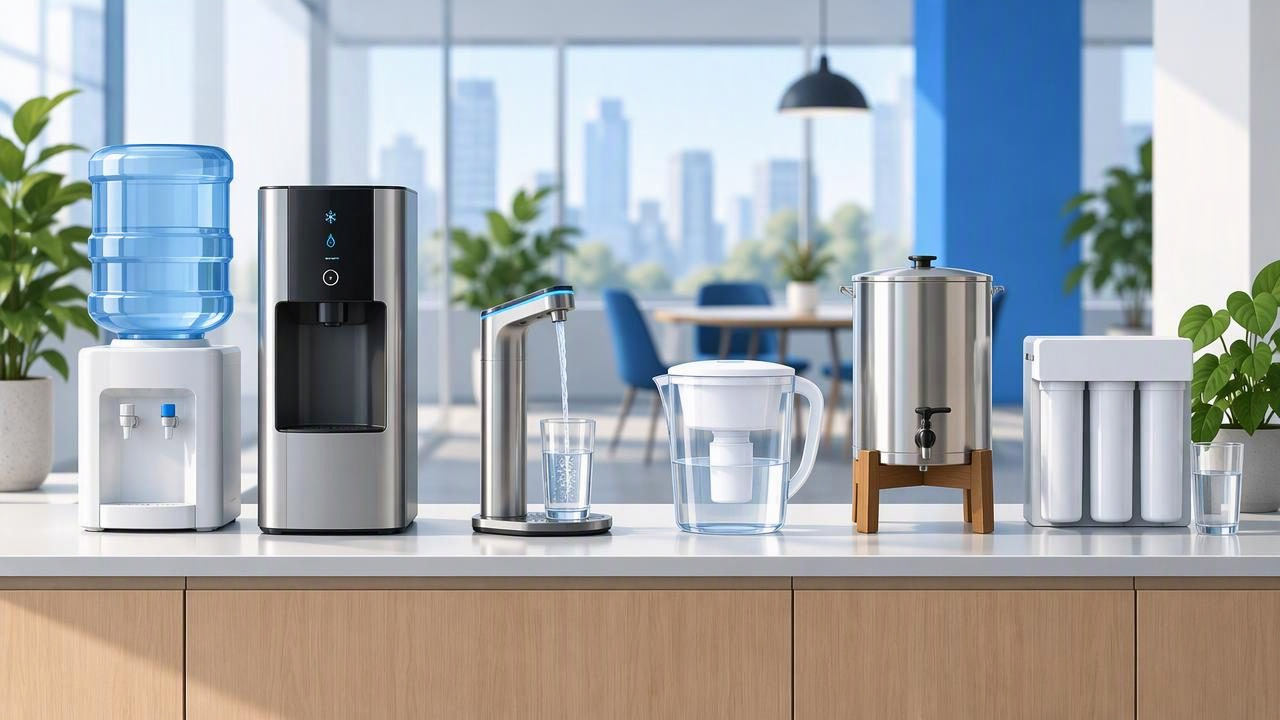
Traditional office water coolers that rely on delivered plastic jugs are familiar, but they are not the only way to give employees convenient drinking water. Bottle deliveries require storage, scheduling, and handling, while empty containers can take up valuable space. Depending on your team size, plumbing, and water preferences, an alternative may be simpler or more economical.
The best choice is not automatically the one with the lowest purchase price. Consider daily use, water quality, installation, ongoing maintenance, and the time your staff spends managing supplies. Here are six office water dispenser alternatives and practical tips for comparing them.
What Counts as an Office Water Dispenser Alternative?
In this guide, an alternative is any system that provides drinking water without depending on routine deliveries of large, prefilled jugs. Options range from filters attached to a faucet to plumbed-in dispensers that chill and heat water. Some offices may also use refill stations alongside individual bottles or cups.
These choices are not interchangeable. A basic carbon filter can improve taste and reduce certain substances, but it does not necessarily remove dissolved minerals or every contaminant. A reverse osmosis system uses a different treatment process and may be appropriate for specific water concerns. Start with what your office needs rather than assuming every filter provides the same result.
Six Alternatives to Traditional Bottled Coolers
1. Bottleless, Plumbed-In Water Cooler
A bottleless cooler connects to a building’s water supply and filters water at the point of use. Many models provide chilled and room-temperature water, and some offer hot water. Since the unit does not rely on delivered jugs, it can reduce storage needs and the work of lifting and replacing heavy bottles.
This option can suit offices with steady daily use and a convenient water line. It typically requires professional installation, scheduled filter changes, and access to a drain if the model needs one. Ask which contaminants the selected filters are certified to reduce, and confirm that the system is sized for your expected number of users.
2. Under-Sink Filtration With a Dedicated Faucet
An under-sink filter treats water at one kitchen or break-room sink. It keeps the counter mostly clear and provides a convenient refill point for reusable bottles, pitchers, or cups. Depending on the system, filtration may use carbon, reverse osmosis, or multiple treatment stages.
This can be a good fit for smaller teams that do not need a freestanding cooler. However, it may not provide chilled water, and employees must fill their own containers. Check available cabinet space, plumbing requirements, filter replacement costs, and whether the unit includes a separate faucet.
3. Countertop Water Filter
A countertop filter can be installed with little or no permanent plumbing, depending on the model. It is useful for leased offices or businesses that want a smaller initial commitment. Some units connect to a faucet; others use a refillable reservoir.
Capacity matters. A compact unit may need frequent refilling in a busy workplace, and counter space can be limited. Read the product’s performance information carefully: a filter designed mainly to improve taste is not equivalent to a system tested for a particular health-related contaminant.
4. Filtered Water Pitchers or Dispensers
Pitchers and larger refrigerator-style dispensers have a relatively low entry cost and do not usually require installation. They can work for a small team with modest water use, especially when there is refrigerator space and someone is responsible for refilling and cleaning them.
For a larger office, the workload can outweigh the simple setup. Pitchers have limited capacity, replacement cartridges must be tracked, and shared containers need regular washing. Confirm the filter’s rated capacity and replacement interval rather than estimating based on appearance or taste.
5. Reverse Osmosis Refill Station
A point-of-use reverse osmosis (RO) system pushes water through a semipermeable membrane and may reduce a range of dissolved substances, depending on the system and its certifications. Some office RO units include storage and a dispensing tap; others combine RO with a bottleless cooler.
RO is not automatically the right answer for every workplace. Systems need maintenance, may produce wastewater during treatment, and can reduce minerals as well as unwanted substances. Ask a qualified provider whether the water test results justify RO and whether the unit’s documented performance matches your concerns.
6. Refill Stations and Reusable Bottles
A filtered bottle-filling station can make it easy for employees and visitors to refill reusable bottles, particularly in a gym, school, warehouse, or office with several floors. Some stations connect to existing plumbing and include a filter; others may simply provide a convenient tap. Verify what treatment is actually included.
Reusable bottles alone are not a treatment solution, but they can complement a filtered water source and reduce reliance on disposable bottles. The station’s location, accessibility, refill speed, and cleaning plan all affect whether people will use it.
Quick Comparison of Office Water Options
| Option | Installation | Best suited to | Consider |
|---|---|---|---|
| Bottleless cooler | Usually plumbing required | Regular, moderate-to-high use | Filter service and site requirements |
| Under-sink filter | Cabinet and faucet work | Small teams and shared kitchens | No built-in chilling on many models |
| Countertop filter | Often minimal | Leased or compact offices | Counter space and capacity |
| Pitcher | None | Low-volume use | Refilling, cleaning, and cartridges |
| RO station | Often plumbing required | Specific dissolved-contaminant concerns | Maintenance and wastewater |
| Refill station | Varies by model | High-traffic refill points | Placement and actual filtration |
Compare Total Cost, Not Just the Equipment Price
To compare office water dispenser alternatives fairly, estimate costs across the period you expect to use the system. Include equipment or rental charges, installation, water, electricity where applicable, replacement filters, service visits, delivery fees, and staff time. For a jug service, also account for bottle deposits or dispenser charges if they apply, plus the space used to store full and empty containers.
A simple estimate can help:
Estimated annual cost = equipment and installation + service and filters + water and energy + delivery or supply costs.
Then divide that amount by the number of people served or the estimated gallons dispensed. Use actual invoices and realistic usage figures when possible. A plumbed system may have a higher setup cost but fewer recurring deliveries; a pitcher may cost less upfront but require more staff attention. Results vary by office, local utility rates, service plan, and usage, so avoid relying on generic savings claims.
How to Choose the Right Option for Your Office
- Estimate demand. Count regular users and consider visitors, shifts, and seasonal changes. A solution that works for six people may frustrate a team of sixty.
- Review the water and building. Check whether you have a nearby water line, cabinet space, electrical access, and permission to make plumbing changes. In South Florida, municipal water characteristics vary by service area. Hardness can affect scale and equipment, while chlorine can influence taste and odor. Test the water if you have a specific concern instead of choosing treatment by guesswork.
- Match treatment to the concern. Look for independent performance certifications, such as applicable NSF/ANSI standards, and verify which substances a specific model is certified to reduce. No single filter removes everything. If you are concerned about lead, PFAS, sulfur, or another contaminant, use appropriate testing and confirm the treatment claims for that exact system.
- Plan for accessibility and convenience. Place the water source where people can reach it without blocking walkways. Consider whether employees need chilled or hot water, bottle-filling clearance, or accessible controls.
- Assign maintenance responsibility. Decide who will track filter changes, clean shared surfaces, and report problems. A system without a clear service plan can lose performance or become inconvenient.
Maintenance and Hygiene Still Matter
Every shared water option needs routine care. Follow the manufacturer’s schedule for changing cartridges and sanitizing reservoirs, taps, and refill areas. Filter life depends on the model and how much water passes through it; a calendar reminder is useful, but it should not replace the product’s capacity guidance. Keep records of installation and service dates.
For bottleless systems, ask whether maintenance is included in the service agreement and what happens if a unit leaks or stops chilling. For pitchers and countertop units, wash containers as directed and avoid topping up old water indefinitely. Encourage employees to clean personal reusable bottles regularly. If taste, odor, or flow changes suddenly, investigate rather than assuming the filter is working normally.
Make the Choice That Fits Your Workplace
The strongest office water dispenser alternative is the one employees will use and your business can maintain. Small offices may prefer a pitcher or under-sink filter, while busier workplaces may benefit from a bottleless cooler or refill station. RO can be worth evaluating when testing identifies a relevant water-quality concern, but it should not be selected solely because it sounds more advanced.
Compare the full operating cost, confirm the system’s tested performance, and build filter service into your facilities routine. For more practical water-quality guidance for South Florida workplaces, explore the resources from Blog Water News.