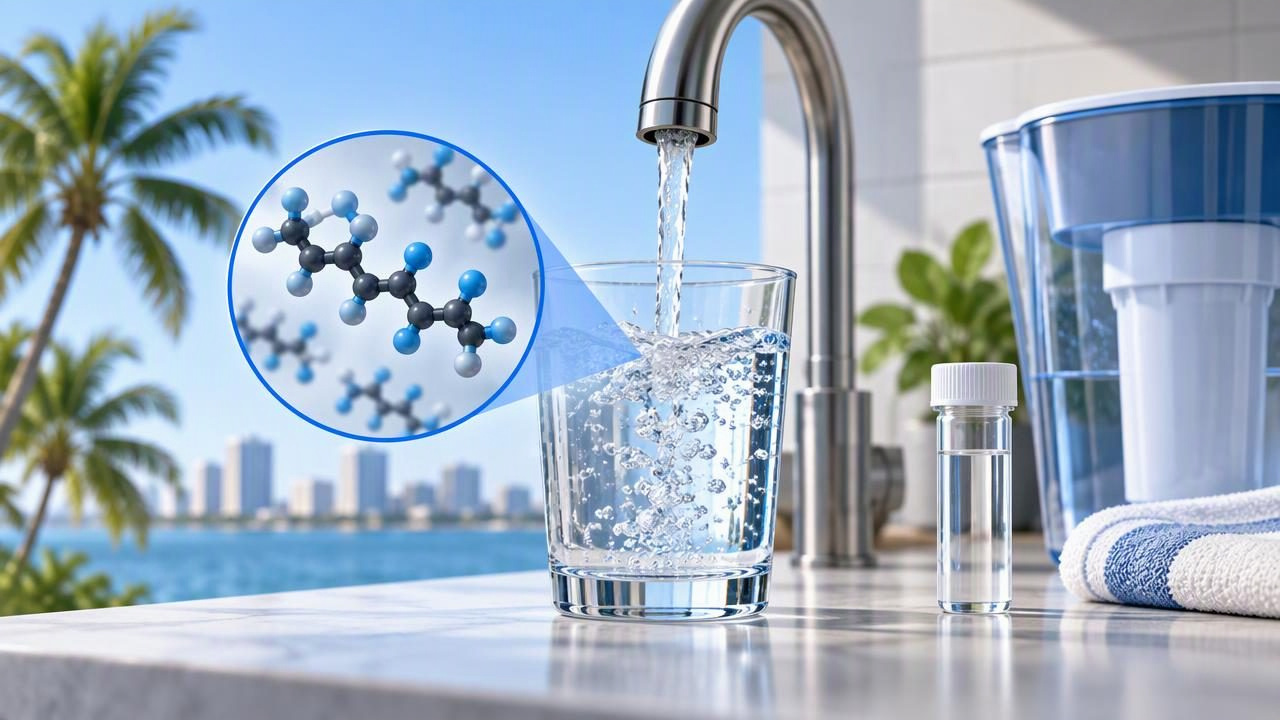
Questions about PFAS contamination in Florida tap water can be unsettling, especially when you rely on your household supply for drinking, cooking, and making baby formula. PFAS are a large group of human-made chemicals that have been used in products and industrial processes for decades. Some persist in the environment and can enter water supplies.
That does not mean every Florida home has PFAS in its water, or that every detected level presents the same concern. Water quality varies by source, treatment system, location, and plumbing. The best next steps are to check reliable local information, test when appropriate, and choose treatment based on verified performance—not broad promises.
What are PFAS?
PFAS, short for per- and polyfluoroalkyl substances, are a broad family of chemicals valued for resisting heat, oil, stains, and water. They have been used in items such as some firefighting foams, food packaging, textiles, and industrial applications. PFOA and PFOS are two well-known PFAS, but they are only part of a much larger group.
Some PFAS break down very slowly, which is why they are often called “forever chemicals.” They can move through soil and water, and certain compounds may remain in people and the environment for a long time. Research has linked exposure to some PFAS with health effects, including changes in cholesterol, immune response, and development. Risk depends on the chemical, amount, duration of exposure, and individual circumstances. A detection alone is not a diagnosis or proof that someone will become ill.
How could PFAS get into Florida drinking water?
PFAS can reach groundwater or surface water through discharges, industrial activity, landfills, and the use of certain firefighting foams. Public water utilities treat source water, but treatment methods differ, and conventional processes are not designed to remove every PFAS compound. Private wells are not covered by the same routine public-system monitoring requirements, so well owners may need to arrange their own testing.
Florida has a mix of groundwater and surface-water sources, and water conditions can differ from one utility or neighborhood to another. A result for a nearby city is not automatically a result for your home. Even homes served by the same utility can have different plumbing, while private wells can vary substantially over short distances.
How to check PFAS levels in your water
If your home receives municipal water, start with the utility’s latest Consumer Confidence Report, also called an annual water quality report. Look for PFAS monitoring results, the chemicals tested, sampling dates, and any notices or follow-up steps. You can also contact the utility directly and ask whether it has tested for PFAS, which compounds were included, and how the results compare with current state and federal guidance.
Reports may not answer every question: monitoring may not include every PFAS compound, and results can change over time. For a private well—or if you want a sample collected at your own tap—use a laboratory accredited for the relevant PFAS testing. Ask the lab how to collect and ship the sample, since bottles, handling, and shipping instructions matter. Common EPA analytical methods include Method 533 and Method 537.1; a qualified lab can explain which method fits your situation.
PFAS results are often reported in nanograms per liter (ng/L), which is equivalent to parts per trillion (ppt). Compare your result with the applicable current health standard or advisory, not an old online chart. Federal PFAS rules, implementation dates, and state guidance can change; check current information from the U.S. EPA and Florida Department of Environmental Protection or ask your water provider for help interpreting a report.
What can reduce PFAS in drinking water?
Several treatment technologies can reduce certain PFAS, but performance depends on the specific device, its certification, installation, and maintenance. A product should not be assumed to remove all PFAS simply because it uses a filter. Check the manufacturer’s performance data and confirm that the exact model is certified for the contaminant you want to reduce.
| Treatment type | What to know |
|---|---|
| Activated carbon | Some properly designed carbon filters can reduce certain PFAS. Capacity and results vary by compound and filter life, so verify the product’s specific claims and replacement schedule. |
| Reverse osmosis (RO) | RO systems can reduce a range of dissolved contaminants, including some PFAS, when tested and maintained as directed. They require periodic filter and membrane replacement. |
| Ion exchange | Specialty resins may remove targeted PFAS. These systems need proper sizing, upkeep, and responsible handling of spent media. |
Look for independent certification to an applicable NSF/ANSI standard and verify the listing for the exact model. NSF/ANSI 53 and NSF/ANSI 58 cover different kinds of treatment claims; a standard number alone does not guarantee PFAS reduction. Check the certification directory or performance sheet for the particular substance named. A qualified water professional can help match a system to a lab report and your household’s needs.
What does not reliably solve a PFAS concern?
- Boiling: Boiling water does not destroy PFAS and can concentrate contaminants as water evaporates.
- Pitcher filters by assumption: Some may reduce particular chemicals, but not every pitcher is tested or certified for PFAS. Confirm the exact claim.
- Water softeners: Softeners target hardness minerals such as calcium and magnesium. They are not a substitute for a PFAS treatment system.
- “All-in-one” promises: Be cautious of vague claims such as “removes everything.” Ask for independent data, contaminant-specific results, and a clear maintenance plan.
Bottled water is not automatically free of PFAS, either. If you use it temporarily while investigating a result, review the brand’s available testing information and consider the cost, storage, and waste involved. Ask your utility or health department for advice if a test exceeds an applicable standard or if you are unsure what to do while arranging treatment.
Choosing a home water treatment system
Begin with the problem you are trying to solve. A laboratory report can distinguish a PFAS concern from chlorine taste, sulfur odor, sediment, or hard water. Those issues may need different equipment. For example, a softener can help address scale and mineral buildup, while an RO system is typically installed at a drinking-water tap. Whole-house filtration treats water entering the home but may not be the most efficient choice for every contaminant or budget.
- Review your source. Check the utility report or test your well through an accredited lab.
- Identify the target. Match the treatment to the specific PFAS compounds and levels reported.
- Verify performance. Request independent certification or model-specific test data for the exact contaminant.
- Plan for upkeep. Confirm replacement intervals, service costs, and how the system signals that filters need changing.
- Retest if appropriate. Follow lab, utility, or health-agency guidance to confirm a system is working as intended.
Maintenance is essential. A neglected carbon cartridge or RO membrane may not perform as expected, even if the system was effective when new. Keep a record of installation and filter changes, use the specified replacement parts, and avoid extending service intervals just because water still tastes normal. PFAS cannot be reliably detected by taste, smell, or appearance.
Practical steps for South Florida households
For municipal customers, save the latest water quality report and note any PFAS data or utility updates. For well owners, ask a certified lab about PFAS testing and whether other locally relevant water tests make sense. If you rent, ask the property manager or water provider about the source and any available results. When shopping for treatment, bring a copy of the report and get written details about performance, installation, and ongoing costs.
PFAS contamination in Florida tap water is a real issue to investigate, but it should be approached with location-specific evidence rather than assumptions. Reliable testing, careful reading of current guidance, and a correctly maintained treatment system can help households make informed decisions. Blog Water News shares practical water-quality guidance for Florida residents; for a specific result, consult your utility, an accredited laboratory, or a qualified water-treatment professional.