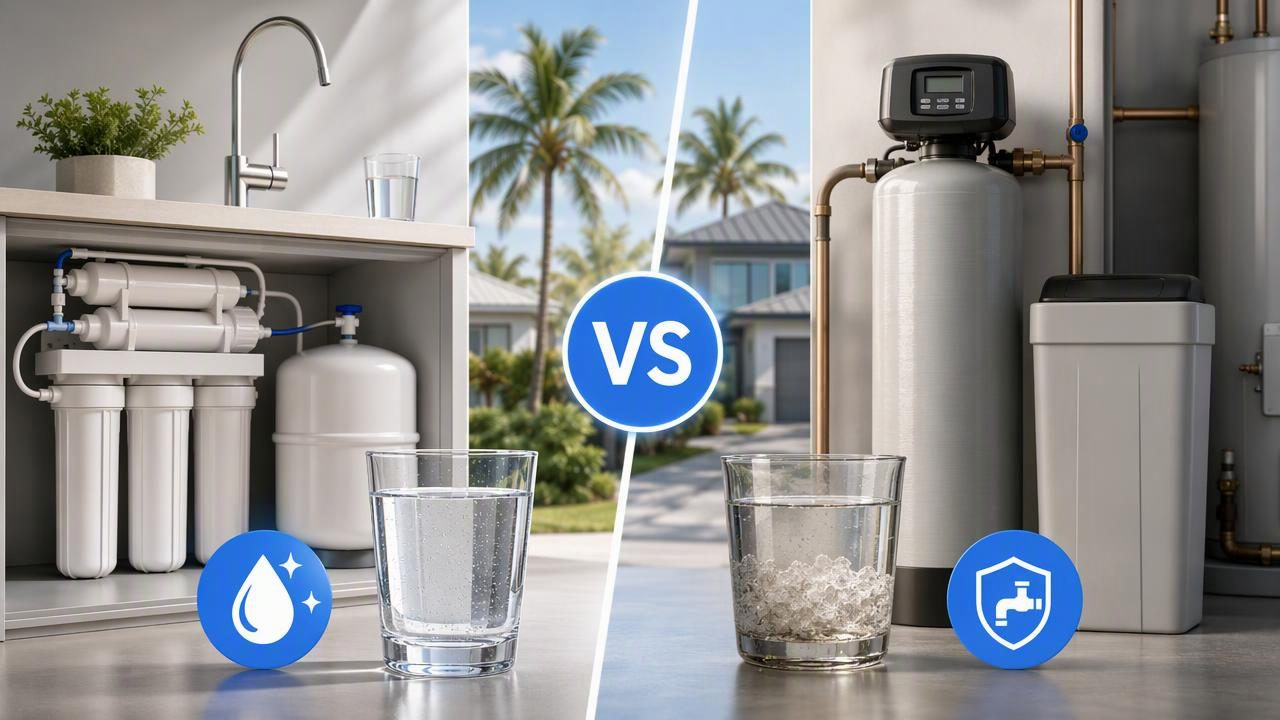
When homeowners compare reverse osmosis vs water softener systems, they are often looking for one simple answer: which one will make their water better? The answer depends on what “better” means for your household. A water softener is designed to address hard-water minerals that create scale, while a reverse osmosis system is designed to reduce many dissolved contaminants in drinking water.
In South Florida, it is common for a home to benefit from both solutions. Local water may be treated and safe for municipal distribution, but it can still contain chlorine-related taste and odor, dissolved minerals, sediment, and trace contaminants that affect the way water tastes, feels, and performs in plumbing fixtures and appliances.
Understanding the differences can help you avoid buying a system that solves the wrong problem. This guide explains how reverse osmosis and water softeners work, what they remove, and how to choose the best setup for your home or business.
What Is the Difference Between Reverse Osmosis and a Water Softener?
The main difference is their purpose. A water softener treats hard water by removing or exchanging calcium and magnesium minerals. A reverse osmosis system, often called an RO system, uses a specialized membrane to reduce a broader range of dissolved substances from drinking water.
| Feature | Water Softener | Reverse Osmosis System |
|---|---|---|
| Primary purpose | Reduce hardness minerals | Improve drinking-water quality |
| Common installation point | Whole-house water line | Under kitchen sink or point of use |
| Best for | Scale, soap scum, dry skin, appliance protection | Taste, odor, dissolved solids, select contaminants |
| Typical treatment method | Ion exchange | Membrane filtration with prefilters |
| Uses salt? | Usually, yes, in salt-based systems | No salt required |
| Provides water for | Showers, laundry, plumbing, appliances, faucets | Drinking, cooking, coffee, ice, pet water |
Neither system is automatically “better.” They solve different water-quality challenges, and they may be most effective when used together.
How a Water Softener Works
Hard water contains elevated amounts of calcium and magnesium. As hard water moves through pipes or heats inside a water heater, dishwasher, washing machine, or coffee maker, these minerals can form a crusty buildup called scale. In South Florida, mineral content can vary substantially by municipality, source water, and whether a property uses city water or a private well.
A conventional salt-based water softener uses ion exchange. Resin beads inside the unit attract calcium and magnesium ions and exchange them for sodium or potassium ions. During regeneration, the system flushes accumulated minerals from the resin using a brine solution.
Signs You May Need a Water Softener
- White spots on glasses, shower doors, and faucets
- Soap that does not lather easily or leaves a film behind
- Stiff laundry, faded fabrics, or frequent detergent use
- Scale buildup around showerheads and appliance connections
- Reduced water flow caused by mineral buildup in fixtures
- Dry-feeling skin or dull-looking hair after showering
- Shorter life spans for water heaters, dishwashers, and ice makers
A softener does not usually remove chlorine, lead, PFAS, bacteria, pesticides, or many dissolved chemical contaminants. It also does not function as a complete drinking-water purification system. Its greatest value is protecting plumbing and equipment while improving everyday washing and bathing performance.
How Reverse Osmosis Works
Reverse osmosis is a multi-stage water filtration process. Water typically passes through a sediment prefilter, a carbon filter, an RO membrane, and often a final polishing carbon filter. The membrane has extremely small pores that help reduce many dissolved particles and contaminants before water reaches a dedicated faucet or connected refrigerator line.
Depending on the system design and the incoming water conditions, reverse osmosis can reduce total dissolved solids, chlorine-related taste and odor, certain heavy metals such as lead, fluoride, and many other dissolved substances. Some systems may also be certified to reduce specific contaminants, including PFAS compounds, but homeowners should always verify the product’s NSF/ANSI certification and contaminant-reduction claims.
What Reverse Osmosis Is Best For
- Improving the taste and odor of drinking water
- Reducing sediment and many dissolved solids
- Providing cleaner water for cooking, ice, coffee, tea, and formula preparation
- Reducing exposure to contaminants identified through water testing
- Replacing some reliance on single-use bottled water
Unlike a whole-house softener, most RO units treat a relatively small amount of water at the point of use. That makes them practical for drinking and food preparation, but not for supplying softened water to showers, laundry, or every fixture in the home.
Reverse Osmosis vs Water Softener: What Each System Removes
It is helpful to think about water treatment in categories. Hardness is not the same as contamination, and bad taste is not always caused by the same thing as scale. The table below offers a general comparison. Actual results depend on system configuration, water chemistry, maintenance, and certified performance claims.
| Water Issue | Water Softener | Reverse Osmosis |
|---|---|---|
| Calcium and magnesium hardness | Excellent | Can reduce at drinking tap only |
| Scale on fixtures and appliances | Excellent | No whole-home protection |
| Chlorine taste and odor | Usually no | Yes, with carbon prefiltration |
| Lead and certain heavy metals | No | Often reduced by certified systems |
| PFAS and other emerging contaminants | No | Possible with appropriate certification |
| Sulfur odor from well water | Not typically | Not usually the first-line whole-home solution |
| Drinking-water taste | May improve slightly | Often improves significantly |
Do South Florida Homes Need Both?
Many households do. A whole-house softener can protect the plumbing system and water-using appliances from hardness-related scale, while an under-sink reverse osmosis system can provide purified water where it matters most: the kitchen drinking-water faucet, refrigerator dispenser, and ice maker.
This combination can be particularly useful for families that notice hard-water spotting throughout the house but also dislike the smell or taste of tap water. It can also support healthier hydration by making filtered water convenient for refillable bottles, cooking, smoothies, and daily meals.
Important: The right equipment should follow the water test—not guesswork. Water conditions can differ from one neighborhood to another, even within the same county.
For private well owners, testing is especially important. Well water may have additional concerns such as iron, manganese, sulfur, bacteria, or high sediment levels. These issues may require specialized pretreatment before either a softener or reverse osmosis system is installed.
Water Testing Comes First
A water test gives you a practical starting point. At minimum, homeowners should understand water hardness, pH, total dissolved solids, chlorine or chloramine levels, iron, sulfur, and the presence of contaminants relevant to their water source. If there are concerns about aging plumbing, testing for lead may also be appropriate. Where local reports or personal concerns indicate risk, ask about PFAS testing as well.
Municipal customers can review their local Consumer Confidence Report, but that report describes water leaving the treatment plant. It does not always show what changes occur inside a building’s plumbing or what is present at a specific faucet. A point-of-use test helps identify the conditions that matter in your home.
Maintenance Requirements and Costs
Both systems need maintenance to keep performing as intended. Skipping service can reduce water quality, lower water pressure, and shorten the system’s life.
Typical Water Softener Maintenance
- Add solar salt or potassium chloride as needed, often every one to three months
- Check for salt bridging or mushing in the brine tank
- Clean the brine tank periodically
- Inspect resin and valves during professional service visits
Typical Reverse Osmosis Maintenance
- Replace sediment and carbon prefilters about every 6 to 12 months
- Replace the RO membrane approximately every 2 to 3 years, depending on use and feed-water quality
- Replace polishing filters on the recommended schedule
- Sanitize the system during scheduled maintenance when appropriate
Filter schedules are not identical for every household. Larger families, high sediment levels, and heavily chlorinated water can require more frequent service. Keeping a simple record prevents missed replacements:
System: Kitchen RO
Prefilter changed: March 15
Next due: September 15
Membrane installed: March 15
Estimated membrane review: March 15, two years later
How to Choose the Right System
- Identify the problem. Is it scale, bad taste, sulfur odor, stains, or concern about a specific contaminant?
- Test the water. Do not rely only on a neighbor’s experience or a generic online recommendation.
- Consider where treatment is needed. Whole-home issues call for whole-home equipment; drinking-water concerns may call for RO at the kitchen sink.
- Review certified claims. Match the system’s certifications to the contaminants identified in your test.
- Plan for maintenance. A system is only effective when filters, salt, and service requirements are handled on schedule.
Final Takeaway
In the reverse osmosis vs water softener comparison, the best choice is based on your water goals. Choose a water softener when hard water is damaging fixtures, creating scale, and affecting laundry or bathing. Choose reverse osmosis when you want better-tasting drinking water and targeted reduction of many dissolved contaminants. Choose both when your household needs whole-home protection and purified water at the tap.
For more practical South Florida water-quality guidance, homeowners and businesses can explore resources from Blog Water News.