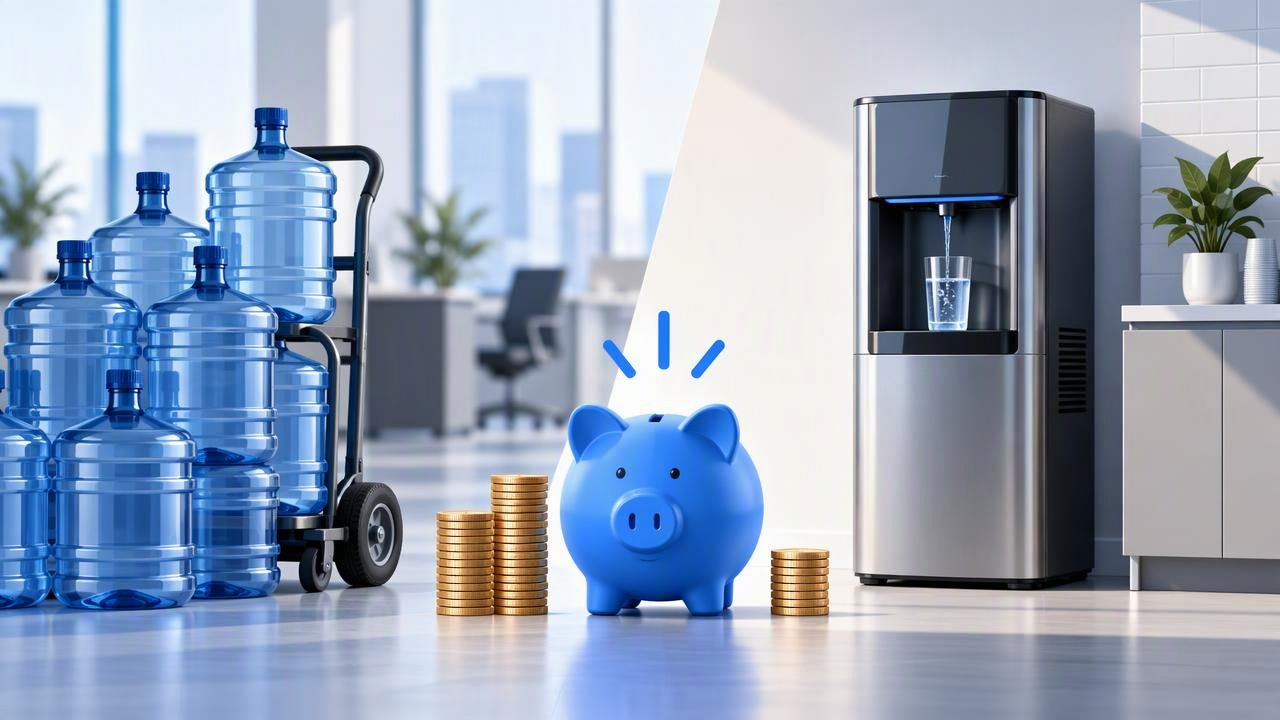
Providing drinking water is a small but recurring operating cost for many South Florida businesses. Offices, salons, clinics, studios, and other workplaces often rely on delivered water jugs or bottled water. The convenience is familiar, but recurring orders, storage needs, and delivery fees can make the real expense easy to underestimate.
Comparing small business water delivery costs with a bottleless filtration system can help you choose an option that fits your budget and daily water use. The right choice depends on more than the price per jug: include equipment, installation, maintenance, electricity, staff time, and the amount of water your team and visitors actually drink.
What Goes Into Water Delivery Costs?
Traditional water service may be billed per jug, per delivery, or through a monthly plan. Rates vary by provider, delivery area, order size, and contract, so request a written quote rather than relying on a general price online. Ask whether the quoted rate includes the dispenser, deposits, delivery, taxes, and account fees.
Also consider how often you order and how much water remains unused. A business that runs short may need an extra delivery, while over-ordering ties up money and storage space. Large jugs can be awkward to move, and staff time spent receiving, storing, and replacing them is part of the practical cost—even when it does not appear on an invoice.
- Water: The per-jug or per-bottle charge and expected monthly volume.
- Delivery: Scheduled or emergency delivery fees, minimum orders, and fuel surcharges.
- Equipment: Rental charges, deposits, or dispenser purchase costs.
- Extras: Cups, cleaning supplies, bottle returns, and possible cancellation fees.
- Operations: Storage space and employee time handling deliveries and refills.
Estimate Your Current Monthly Spend
Start with invoices from the past three to six months. Add the water charges, delivery and service fees, equipment rental, and supplies. Then divide the total by the number of months. If demand changes seasonally, use a full year of records when available. South Florida businesses may see higher use during hot periods or when visitor traffic increases.
For a simple comparison, imagine a small office ordering 20 five-gallon jugs each month. If the delivered price averages $9 per jug, the water alone costs $180 monthly, or $2,160 per year. If delivery, cups, or equipment add $40 per month, the annual total becomes $2,640. These figures are only an example, not a local price quote; replace them with your actual invoices.
Next, estimate annual water use. Multiply the number of jugs by the gallons in each jug, then compare that volume with a filtration system’s expected output. Keep a note of busy weeks, visitors, and water wasted when a jug is changed or left partly unused. A cost comparison is more meaningful when both options are evaluated against the same consumption.
How Bottleless Water Changes the Cost Structure
A bottleless water cooler connects to a water supply and treats water at the point of use. Instead of paying for repeated jug deliveries, the business pays for the equipment and installation, ongoing filter replacements, and any applicable service plan. Depending on the system, treatment may include carbon filtration, reverse osmosis, or additional stages selected for the water and the business’s needs.
This shifts costs rather than eliminating them. There may be an upfront purchase or a monthly lease, plumbing work, and routine maintenance. The business also uses a small amount of electricity if the dispenser chills or heats water. Ask providers to explain which filters are included, how often they are replaced, and whether service visits and repairs are covered.
To estimate the annual cost, add the system payment or equipment cost, installation, maintenance, replacement filters, and electricity. For equipment you purchase, compare costs over the expected useful life rather than treating the full price as a single month’s expense. For a lease, review the full term, service coverage, renewal terms, and fees before signing.
The largest potential savings usually come from reducing recurring water and delivery charges. Savings are not guaranteed: a low-use workplace, an expensive installation, or a service agreement that does not fit your needs can change the result. Compare total costs using realistic usage and written quotes.
Bottled Delivery vs. Bottleless Filtration
| Cost or consideration | Delivered jugs | Bottleless system |
|---|---|---|
| Recurring water expense | Typically based on jug or bottle orders | Usually reduced to filtration and service costs |
| Delivery | Scheduled deliveries and possible extra fees | No routine jug delivery |
| Setup | Often limited, depending on dispenser terms | May require installation and a suitable water connection |
| Maintenance | Dispenser cleaning and bottle handling | Filter changes, sanitation, and system servicing |
| Storage | Requires space for full and empty jugs | Does not require a jug inventory |
| Best fit | Low use or temporary locations | Steady use and a suitable installation site |
This comparison is general. System features and contract details differ, and local water conditions can affect treatment requirements. A workplace should compare options based on its own use, plumbing, and budget.
Other Business Benefits to Consider
Cost matters, but so does convenience. A bottleless cooler can provide a steady supply without deliveries interrupting the workday or staff lifting heavy jugs. Removing bottle storage may free up a closet or break-room area, which can be valuable in compact commercial spaces. Fewer disposable bottles may also reduce workplace waste, although cups and maintenance materials still need consideration.
For small businesses, predictable expenses can make budgeting easier. A fixed service plan may be simpler to plan around than fluctuating delivery orders, but read the agreement carefully to understand what it covers. Ask about response times, replacement parts, filter availability, and what happens if equipment stops working.
Water quality is another factor, particularly in South Florida, where taste, chlorine, hardness, and local supply conditions can influence what employees notice. Filtration should be matched to a specific concern rather than chosen on broad claims. A water test can help identify whether a treatment stage is appropriate. If testing indicates a contaminant such as lead or PFAS, consult a qualified water professional about a treatment system certified for that reduction and follow the product’s maintenance instructions.
How to Make a Fair Cost Comparison
- Gather actual bills. Include water, delivery, rental, supplies, and any one-time charges.
- Measure demand. Record monthly jug use or estimate gallons consumed, including staff and visitors.
- Request complete quotes. Ask for equipment, installation, filter replacements, service, and contract costs in writing.
- Compare the same time period. Calculate total costs over one year and, where relevant, the full contract term.
- Check practical fit. Confirm that the installation location has the needed access to a water line and power, if required.
- Review the exit terms. Look for early termination fees, equipment ownership, and responsibilities at the end of a lease.
A basic formula is: annual delivery cost = yearly water purchases + delivery fees + equipment charges + supplies. For bottleless service, use annual system cost = payments or equipment cost + installation + filters and maintenance + electricity. These formulas do not assign a dollar value to employee time or saved storage, but those factors may matter when choosing between options.
When Does Bottleless Water Make Sense?
A bottleless system may be worth investigating when your business uses water steadily, has space for installation, and spends a substantial amount on recurring deliveries. It can also suit workplaces that want to avoid jug handling or reduce storage demands. Ask for a break-even estimate based on your documented consumption, not a generic promise of savings.
Delivered water may remain practical for a very small team, a temporary site, a location without an accessible connection, or a business with irregular demand. You can also consider a hybrid approach—for example, filtered water for everyday staff use and packaged water for events or emergency supplies.
Whichever option you choose, assign someone to monitor usage and equipment. A simple monthly check of invoices, filter dates, and service records helps catch unnecessary orders and overdue maintenance. Clean dispensers according to the manufacturer’s instructions, and do not assume that filtration removes every possible contaminant.
Questions to Ask Before Choosing a Provider
- What is the complete cost over the first year and the full contract term?
- Are delivery, installation, filters, sanitizing, and repairs included?
- Which contaminants is the system designed and certified to reduce?
- How often does the system need maintenance, and who performs it?
- What are the warranty, cancellation, and equipment ownership terms?
In the end, the best way to control small business water delivery costs is to understand your usage and compare every recurring and one-time expense. For a steady-use workplace, bottleless filtration may reduce delivery dependence and simplify daily operations. For others, delivered water may be the more flexible choice. Use your bills, a water assessment, and transparent quotes to make the decision. Blog Water News shares practical information to help South Florida businesses evaluate water options with confidence.