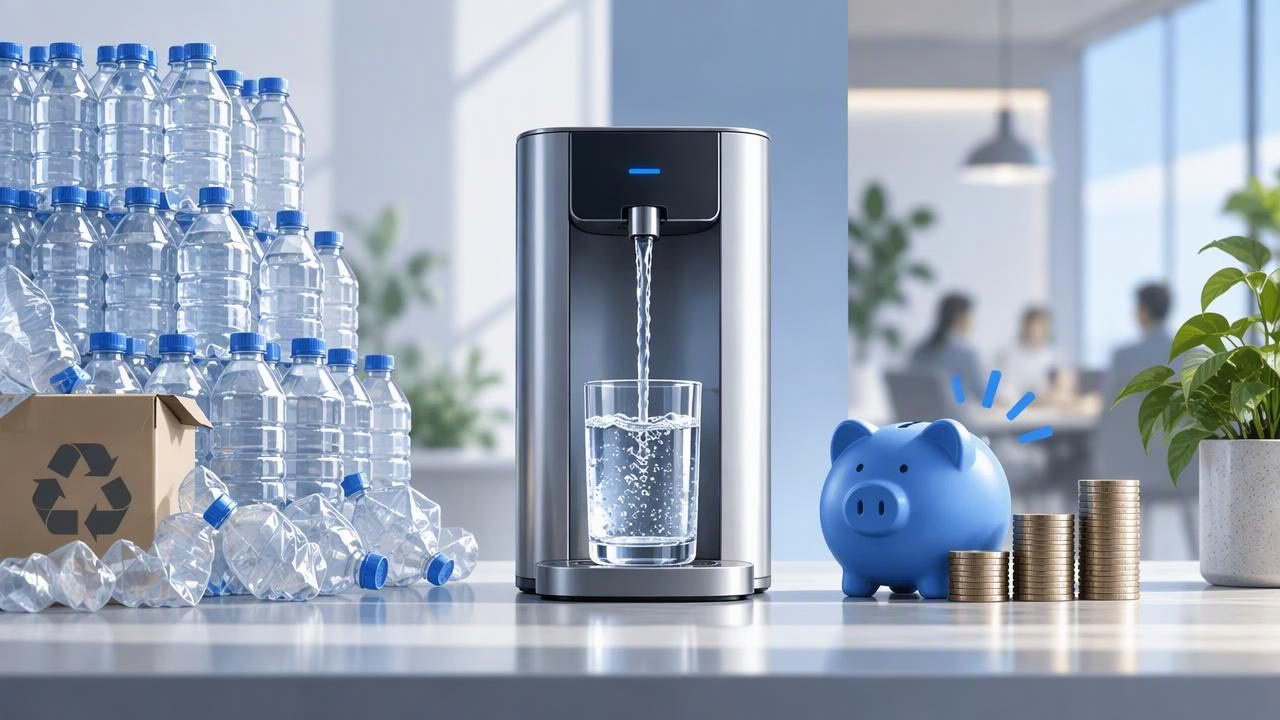
For many businesses, drinking water seems like a small operating expense—until bottled-water invoices, delivery fees, storage needs, and empty containers start adding up. A point-of-use filtration system can provide an alternative: connect a bottleless cooler or filtered-water dispenser to the building’s water supply, then replace filters on schedule. The potential water filtration cost savings for business depend on how much water employees and customers use, the current price of bottled water, and the equipment and service plan selected.
Understanding the full cost—not just the price of a filter—helps owners make a sound decision. This guide explains how to compare bottled water with filtration, which expenses to include, and how to estimate payback for a South Florida workplace.
Why drinking-water costs can be easy to overlook
Businesses often purchase drinking water through recurring deliveries, multipacks, or individual bottles. Those charges may appear across several invoices or purchasing accounts, making the annual total less visible. There can also be indirect costs: staff time spent receiving and stocking cases, floor space used for storage, and time spent handling empty bottles.
These expenses vary by workplace. A small office with a few employees may use relatively little water, while a busy clinic, warehouse, school, or customer-facing business may go through much more. The first step is to review actual purchasing and usage rather than assuming that a filtration system will automatically save money.
Bottled water versus a bottleless filtration system
A bottleless dispenser treats water at the point of use. Depending on the system, treatment may include sediment and carbon filtration, reverse osmosis, or other stages selected for the source water and desired outcome. The unit connects to a cold-water line, and some models provide chilled or hot water. Routine filter changes and service are important to maintain performance.
Bottled delivery works differently: water arrives in containers, which need to be stored and replaced. It can be convenient for locations without a suitable water connection or where installation is impractical. A fair comparison should include all recurring expenses for both options, not simply compare a bottle price with a filter cartridge price.
| Cost category | Bottled-water delivery | Bottleless filtration |
|---|---|---|
| Water supply | Per-bottle or per-case purchases | Building water, usually billed through utilities |
| Equipment | Cooler rental, purchase, or deposit may apply | Purchase, lease, or service-plan cost may apply |
| Ongoing service | Delivery charges and container handling | Filter replacements, sanitation, and maintenance |
| Space and labor | Storage, stocking, and bottle returns | Access for equipment and service |
| Waste | Containers and packaging to manage | Used filters and any packaging to dispose of |
How to estimate water filtration cost savings for business
Use a 12-month comparison and include every relevant cost. Start with invoices for bottled water and cooler service. Add delivery fees, deposits that are not refundable, and any supplies purchased separately. If employees buy individual bottles with a company card, include those transactions too. Avoid counting personal purchases that the business does not pay for.
Then request a complete filtration-system quote. Confirm whether it covers the dispenser, installation, water-line work, filter replacements, preventive maintenance, repairs, and removal or replacement at the end of the agreement. Ask which costs are fixed and which could change. Include the estimated additional utility cost for treated water if it is material; for most workplaces, it is typically small, but actual rates and usage differ.
A simple annual comparison
Annual bottled-water cost = water purchases + delivery + cooler fees + handling supplies
Annual filtration cost = equipment and service + filter costs + installation (annualized) + added utilities
Estimated annual savings = bottled-water cost - filtration cost
For example, imagine a workplace spends $350 each month on water, delivery, and cooler fees. Its annual total is $4,200. A filtration proposal costs $2,700 in the first year, including installation and service. The estimated first-year difference is $1,500. If later years cost $1,900 for service and filters, the projected difference could be greater—but only if usage and prices remain similar. These are sample numbers, not a promise or a typical price; obtain local quotes and use your own invoices.
Calculate a break-even point as well. If installation costs $900 and the system reduces ongoing expenses by $150 per month, the simple payback estimate is six months ($900 divided by $150). This calculation assumes the monthly reduction is real and consistent. A more complete comparison also accounts for financing, contract terms, equipment lifespan, and the value of staff time.
Include operating costs beyond the water bill
Small businesses often focus on direct spending, but workflow matters too. Someone may need to place orders, receive deliveries, move heavy containers, and monitor inventory. Assigning even a modest hourly labor value to those tasks can reveal costs that do not appear as a separate line item.
Storage space has a practical value, particularly in compact South Florida offices, restaurants, and clinics. A bottleless unit may free up room, though it requires an appropriate location, a nearby water connection, and access for maintenance. Consider whether installation would interrupt operations and whether the equipment needs a drain, electrical outlet, or specific clearance.
Waste is another consideration. A bottleless system can reduce dependence on single-use water bottles and large containers, but it is not waste-free: filters and packaging eventually need disposal. Compare the actual products and disposal practices rather than assuming either option has no environmental impact.
Match the treatment to water quality
Filtration is not one-size-fits-all. Municipal water in South Florida is treated, but water quality and taste can vary by location, building plumbing, and the condition of fixtures. Chlorine can affect taste and odor. Older plumbing may raise questions about lead, while PFAS and other contaminants require treatment technologies chosen for the specific substance. Hardness minerals can cause scale, but a water softener addresses a different issue from a drinking-water filter.
Start by reviewing the local water utility’s water-quality report and, if there is a specific concern, arrange appropriate testing. A test should identify what is being measured and use a qualified laboratory when needed. Then check that the proposed system is certified or independently tested for the contaminant of concern. A general-purpose filter should not be assumed to remove every contaminant.
For drinking and food-preparation points, carbon filtration may improve chlorine taste and odor. Reverse osmosis uses a membrane and can reduce a broader range of dissolved substances when the unit is designed and maintained for them. The right choice depends on test results, volume needs, water pressure, wastewater requirements, and the manufacturer’s specifications. Ask the provider to explain performance claims in plain language.
Maintenance protects both performance and budget
A filtration system only delivers its intended performance when serviced according to its specifications. Filter life depends on the treatment technology, incoming water, and how much water passes through the unit. A busy office may need more frequent replacement than a small workplace. Keep a service log with installation dates, cartridge changes, sanitation, and any performance issues.
- Confirm the schedule: Get the manufacturer’s recommended replacement intervals in writing.
- Track usage: Note changes in taste, flow, or volume that may signal a service need.
- Clarify coverage: Check whether filter parts, labor, sanitation, and emergency repairs are included.
- Budget for upkeep: Compare the cost of scheduled service with the cost of missed maintenance and downtime.
Do not delay a required filter change simply to reduce short-term expenses. A clogged or overdue cartridge can restrict flow, affect water quality, and increase the chance of an unplanned service call. Conversely, replacing filters more often than the system requires can waste money. Follow the stated schedule and ask for service records.
Questions to ask before choosing a system
Request answers to practical questions before signing a purchase, lease, or service agreement. A lower monthly payment may not be the lowest total cost if it excludes installation or maintenance. Compare offers using the same assumptions about water volume, service frequency, and contract length.
- What is the complete first-year cost, and what should we expect in later years?
- Which contaminants is the system designed and certified to reduce?
- How many users or gallons per day can the equipment support?
- Who replaces filters, and are parts and labor included?
- What happens if the unit needs repair or the business relocates?
- Are there contract, cancellation, or end-of-term charges?
- Can the provider document installation, maintenance, and water testing?
When filtration may not save money
A bottleless system is not automatically the economical choice. A low-volume office with inexpensive water access and no delivery fees may not recover installation costs quickly. A building that needs extensive plumbing work can face a higher upfront expense. Businesses with temporary premises, limited access to a water line, or highly seasonal occupancy should account for those constraints.
There are also operational questions. A dispenser must be placed where employees can use it, and someone should know how to report a leak or service issue. If the business has a strict procurement policy, confirm that the equipment and service contract meet its requirements. In some settings, sealed bottled water may be necessary for emergency readiness or specific customer needs, even if a filtration system handles everyday use.
A practical decision for South Florida businesses
To evaluate water filtration cost savings for business, collect a year of water-related invoices, estimate consumption, and compare the full costs of delivery and filtration. Check the water-quality concerns relevant to your building, verify treatment claims, and include maintenance and installation in the calculation. Revisit the comparison if employee numbers or water use change.
The best system is one that fits the business’s water quality, daily demand, space, and budget—not simply the one with the lowest advertised monthly price. For more practical water-quality and filtration guidance, readers can explore the resources published by Blog Water News.