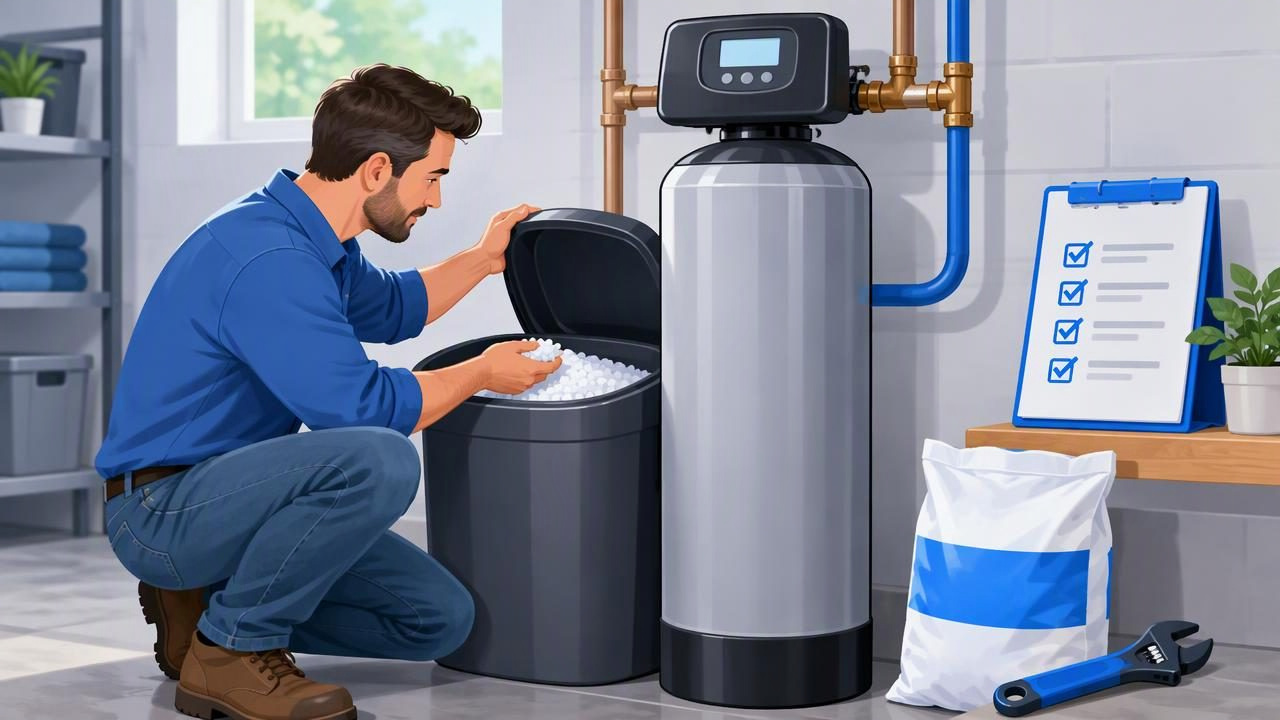
A water softener can help reduce scale on plumbing fixtures, protect appliances, and make hard water more comfortable to use. But like any home equipment, it needs regular attention. A clear water softener maintenance schedule helps you catch small issues before they affect performance, waste salt, or leave hard water flowing through your home.
There is no single schedule that suits every system. Household water use, incoming water hardness, equipment design, and manufacturer instructions all matter. The routine below is a useful starting point for many residential systems, including those used in South Florida. Always follow the manual for your specific model, and contact a qualified water treatment professional when a task requires specialized tools or adjustments.
Water Softener Maintenance Schedule at a Glance
Use this checklist as a general guide, not a substitute for your owner’s manual. Some modern systems monitor salt use or water flow automatically, while older models may need more frequent checks.
| Frequency | Maintenance task | What to check |
|---|---|---|
| Monthly | Inspect the brine tank | Check salt level, moisture, and signs of a hard crust or salt bridge. |
| Every 2–3 months | Check salt use and system operation | Look for unexpected changes in salt consumption, regeneration, or water softness. |
| Every 6–12 months | Clean the brine tank if needed | Remove accumulated residue according to the manual. |
| Annually | Inspect the full system | Review settings, connections, bypass valve, and any prefilter or drain components. |
| As recommended | Replace filters or service components | Use the manufacturer’s interval and adjust for water quality and household use. |
Monthly: Check Salt and Look for Salt Bridges
Start by checking the brine tank about once a month. Salt helps the softener regenerate its resin, so the tank should not run empty. As a general rule, keep the salt above the water level but avoid filling the tank to the very top. Your system’s manual may specify a preferred fill level or salt type.
While checking the level, look for a salt bridge: a hard crust that forms across the top of the salt, leaving an empty space underneath. A bridge can make the tank look full even when the water below cannot dissolve enough salt. Humidity, temperature changes, and overfilling can contribute to bridging. Do not hit the tank with a sharp tool. Follow the manufacturer’s directions to break up the crust safely, or ask a technician if it is difficult to remove.
Also notice whether the salt is unusually wet, clumped, or discolored. These signs do not always mean the system has failed, but they are worth investigating. Use only salt approved for your equipment, and avoid adding cleaning agents or other substances unless the manual specifically instructs you to do so.
Every Few Months: Check How the System Is Running
A softener generally regenerates automatically, but it still helps to review its display or controls every two to three months. Confirm the time is correct, check for error messages, and make sure the unit has not been left in bypass mode. A power interruption can reset some settings, depending on the model.
Pay attention to salt use, too. A sudden increase may point to a setting issue, a leak, or a control problem. Salt use that drops sharply could mean the unit is not regenerating as expected—or that household water use has changed. Neither pattern is proof of a fault by itself; compare it with your normal household routine and the system’s recommendations.
If your softener has a visible drain line, check that it is secure and unobstructed. Do not disconnect it while the unit is operating. The drain carries regeneration water away, so a loose or blocked line can create a mess or interfere with the cycle.
Every Six to Twelve Months: Clean the Brine Tank When Needed
Some systems need only occasional tank cleaning, while others may collect sediment or salt residue sooner. The manufacturer’s manual is the best source for the correct interval and procedure. If the tank has visible buildup, follow the specified steps, taking care not to damage the float, screen, or other parts inside.
Before cleaning, check whether the procedure requires putting the softener into bypass or shutting off water. If you are unsure, have a professional handle it. Never mix household chemicals in the tank or use a cleaner that is not approved for your system. After cleaning, confirm that the tank is reassembled correctly and that the unit returns to normal operation.
Annually: Review Settings and Inspect the Installation
At least once a year, take a closer look at the softener and the area around it. Check for drips, corrosion, damaged tubing, loose connections, and signs of water around the unit. Make sure the bypass valve is accessible and that the control head is protected from accidental bumps. Keep the area clear enough for inspection and service.
It is also a good time to review the hardness setting and household capacity settings. These should reflect the water conditions and the number of people using water in the home. Do not change settings based on guesswork: a setting that is too high can waste salt and water during regeneration, while one that is too low may leave hardness untreated. If your water source or household needs have changed, consider testing the water and asking a qualified technician to confirm the settings.
Signs Your Water Softener May Need Attention
Maintenance checks are useful, but changes in the water can be an early warning. Look for several signs together rather than relying on one symptom:
- New spots or scale on faucets, shower doors, or dishes.
- Soap that seems harder to rinse, or laundry that feels stiff.
- A change in how often the unit regenerates or how quickly it uses salt.
- Error codes, unusual sounds, or water pooling near the equipment.
- A noticeable change in water feel or performance compared with your usual experience.
These clues do not identify the cause on their own. For example, spotting can have other causes, and a water softener does not remove every substance that can affect taste, odor, or appearance. A water test can help separate hardness from other water quality concerns.
South Florida Considerations: Test the Water, Not Just the Equipment
Water conditions vary by location and source, even within South Florida. A softener is designed primarily to address hardness minerals, such as calcium and magnesium. It is not a complete water purification system and should not be expected to remove chlorine, lead, PFAS, sulfur, or microorganisms unless a separate treatment process is specifically designed and certified for those contaminants.
If you notice a new odor, discoloration, or unexplained change in water quality, test before changing the softener settings. A certified laboratory or qualified water treatment provider can help identify appropriate testing. When selecting any filtration equipment, check its certification and the specific contaminant reduction claims; a general label such as “water filter” does not establish that it treats a particular concern.
For homes with a separate sediment or carbon prefilter, follow that filter’s replacement interval. Prefilter schedules can depend on sediment levels, usage, and the manufacturer’s guidance. A clogged filter may reduce flow and affect the equipment downstream, while a filter left in place beyond its service life may not perform as intended.
Common Maintenance Mistakes to Avoid
- Letting the tank run empty: Check it regularly, especially after a period of heavy water use or when you are away from home.
- Overfilling with salt: Excess salt can make inspections harder and may contribute to bridging in some conditions.
- Ignoring the manual: Controls, cleaning instructions, and salt recommendations differ by model.
- Changing settings without testing: Incorrect settings can lead to poor results or unnecessary regeneration.
- Assuming softness means safe drinking water: Softening and contaminant filtration are different treatment goals.
When to Call a Water Treatment Professional
Call for service if the unit repeatedly shows an error, leaks, fails to regenerate, or continues to deliver hard water after you have checked the salt and bypass position. Professional inspection may also be appropriate if the system is older, the control settings are unclear, or a brine tank needs cleaning beyond what the manual describes.
When arranging service, share the model number, any error code, recent changes in salt use, and what you have observed at taps or appliances. This information can make troubleshooting more efficient. If you have not tested your water recently, ask whether a hardness test or broader water analysis is appropriate before replacing parts or adjusting the system.
Build a Routine That Fits Your Home
A dependable water softener maintenance schedule does not need to be complicated: inspect salt monthly, check system operation every few months, clean the brine tank when the manual or its condition calls for it, and review the installation annually. Keep a note of salt additions, filter changes, service visits, and any changes in water quality. A simple record helps you spot patterns and gives a technician useful background if a problem develops.
With routine care and correctly matched treatment, a softener can be one part of a practical home water plan. For more South Florida homeowner guidance, Blog Water News covers water quality, filtration, and maintenance topics to help readers make informed decisions.