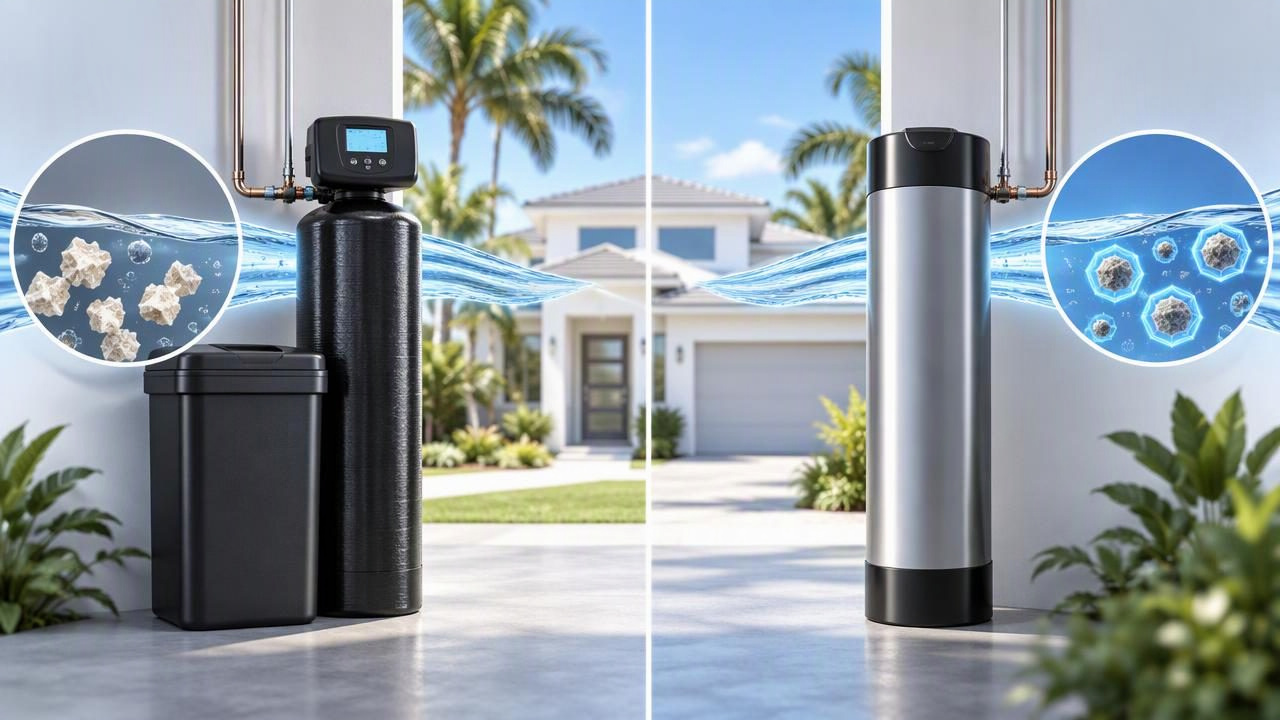
Hard water can leave spots on glassware, make soap harder to rinse, and contribute to scale buildup in pipes and appliances. If you are comparing a water softener vs. water conditioner, the key difference is how each system deals with hardness minerals. A traditional softener removes calcium and magnesium from water. A conditioner generally changes how those minerals behave or reduces their tendency to form scale, without removing them.
Neither option is automatically best for every household. Your water source, hardness level, plumbing, maintenance preferences, and goals all matter. Here is how the two technologies work and what South Florida homeowners should consider before choosing.
What Makes Water Hard?
Water is considered hard when it contains elevated amounts of dissolved calcium and magnesium. These minerals are naturally present in groundwater and can enter a home’s supply as water moves through soil and rock. Hardness is usually measured in grains per gallon (gpg) or milligrams per liter (mg/L). A water test can show your actual level; taste and visible scale are clues, but they are not precise measurements.
Hard water is not generally a health concern for most people, but it can be frustrating and costly to manage. Mineral deposits may collect on fixtures and inside water heaters, dishwashers, and other equipment. You might also notice cloudy glassware, stiff laundry, soap residue, or a film on shower doors. These effects vary with water chemistry, temperature, and how much water your household uses.
How Does a Water Softener Work?
A conventional ion-exchange softener uses a tank filled with resin beads. As hard water passes through, the resin captures calcium and magnesium and exchanges them for sodium or, in some systems, potassium ions. The result is softened water with much lower concentrations of hardness minerals. Periodically, a brine solution regenerates the resin, rinsing away collected minerals so the system can continue working.
Softening can help reduce scale formation and make soap lather more readily. Many households also find that dishes, fixtures, and laundry are easier to clean. Because the system removes hardness minerals, it can be a good fit when hard water is measured at a level that causes persistent scale or cleaning problems.
There are trade-offs. A softener needs salt or potassium, periodic regeneration, and appropriate drain access. Regeneration uses water, and the amount depends on the system and household demand. Since ion exchange adds sodium to the softened water, people following a sodium-restricted diet may want to ask a healthcare professional whether they should use an unsoftened drinking-water tap. A separate reverse osmosis drinking-water system may be an option to discuss with a qualified water-treatment professional.
How Does a Water Conditioner Work?
“Water conditioner” is a broad term rather than one single technology. Many products marketed for hard water use template-assisted crystallization (TAC), electromagnetic or electronic treatment, or other scale-control methods. Some systems encourage hardness minerals to form microscopic crystals that are less likely to attach to surfaces. The minerals remain in the water, so a conditioner generally does not make hard water chemically soft.
A conditioner may appeal to homeowners who want to limit scale without a brine tank, salt purchases, or the same type of regeneration cycle used by a softener. Depending on the technology, it may require little routine attention beyond replacing a cartridge or checking the unit. However, results can depend on water chemistry, flow rate, temperature, and the specific product. Scale control is not the same as removing hardness, and it may not resolve soap performance, spotting, or other symptoms in the way a softener can.
Check the manufacturer’s documented performance claims and the conditions under which they were tested. Ask whether the product is intended to reduce scale, remove minerals, or do both. Independent certification for a specific performance claim can make comparisons easier; do not assume that a device treats contaminants simply because it is described as a conditioner.
Water Softener vs. Water Conditioner: Key Differences
| Feature | Water softener | Water conditioner |
|---|---|---|
| Primary approach | Removes calcium and magnesium through ion exchange | Typically aims to reduce scale effects while minerals remain |
| Water hardness after treatment | Lower | Usually unchanged on a hardness test |
| Common upkeep | Salt or potassium, regeneration, and periodic checks | Varies by technology; may include cartridge or system checks |
| Potential benefits | Can improve soap lather and reduce mineral residue | May help control scale without conventional brine regeneration |
| Important limitation | Uses resources and adds sodium or potassium ions | Does not necessarily remove hardness or improve every hard-water symptom |
These are general distinctions. Product design and performance vary, so compare the actual specifications and service requirements of the systems you are considering.
What Should South Florida Homeowners Consider?
South Florida water can vary by city, utility, building, and source. Some homes receive treated municipal water; others rely on private wells. Hardness is only one part of water quality. Disinfectant taste or odor, iron, sulfur, sediment, and other concerns may require different treatment methods. A softener or conditioner is not a universal filter for contaminants such as lead or PFAS.
Start with a water test that measures hardness and addresses any concerns specific to your supply. If you use well water, testing may need to cover additional parameters, since conditions can differ from one property to another. For municipal water, review the utility’s water quality report, but remember that it describes the public system—not necessarily changes within your home’s plumbing.
Test results can help you avoid buying equipment you do not need. For example, if hardness is modest and your main concern is scale, a scale-control conditioner may be worth investigating. If measured hardness is high and you want softer-feeling water or better soap performance, a conventional softener may be more appropriate. If your concern is drinking-water taste or a particular contaminant, you may need a certified filtration or reverse osmosis system instead.
How to Choose the Right System
- Identify the problem. Note where scale appears, whether soap rinses poorly, and which appliances are affected. Distinguish hardness symptoms from odor, color, or taste issues that may have another cause.
- Test before you shop. Get a reliable hardness measurement and test for other relevant concerns. Use results to guide system sizing and treatment—not assumptions based on a neighbor’s water.
- Decide what “better water” means to you. If you want minerals removed, a conditioner that leaves hardness unchanged may not meet your expectations. If your priority is scale control with less routine salt handling, compare conditioner technologies carefully.
- Compare total ownership needs. Ask about purchase or installation cost, salt or cartridge expenses, water use, maintenance, warranty, and expected service life. Confirm what happens if water conditions change or the system needs repair.
- Check your home’s plumbing and use. Household size, peak flow, available installation space, drain access, and water-heater type can affect the right system. A qualified professional can help match capacity to actual demand.
Common Misunderstandings
“A conditioner removes hardness.” Usually, it does not. Many conditioners target scale behavior while leaving calcium and magnesium in the water. Ask what a post-treatment hardness test should show.
“All conditioners work the same way.” They do not. Technologies and evidence differ, so compare the specific model’s performance claims rather than relying on the category name alone.
“A softener filters every contaminant.” A softener is designed to address hardness through ion exchange, not to serve as a complete drinking-water purifier. Treatment for chlorine, lead, PFAS, or other contaminants calls for testing and a system suited to that specific target.
“No visible scale means no problem.” Visible deposits are useful clues, but water testing is the way to measure hardness. Conversely, spots or residue can have causes beyond hardness, so testing helps identify the right response.
Maintenance and Follow-Up
Follow the manufacturer’s schedule for either system. For a softener, check salt levels, keep the brine tank clean as directed, and arrange service if you notice a return of hard-water symptoms. For a conditioner, replace cartridges or service components at the specified intervals. A periodic water test can confirm whether the system is performing as expected; for a conditioner, evaluate its stated scale-control outcome rather than expecting hardness to disappear.
Keep records of test results, filter changes, and service visits. If plumbing work, a new well, or a change in water source occurs, retest before assuming your existing treatment setup is still appropriate.
Bottom Line
Choose a water softener when your goal is to remove calcium and magnesium and you are comfortable with its salt, regeneration, and maintenance needs. Consider a water conditioner when your priority is scale management and you understand that hardness minerals may remain. In either case, start with a water test and compare performance claims, ongoing costs, and household needs. For more practical South Florida water guidance, explore the resources from Blog Water News.