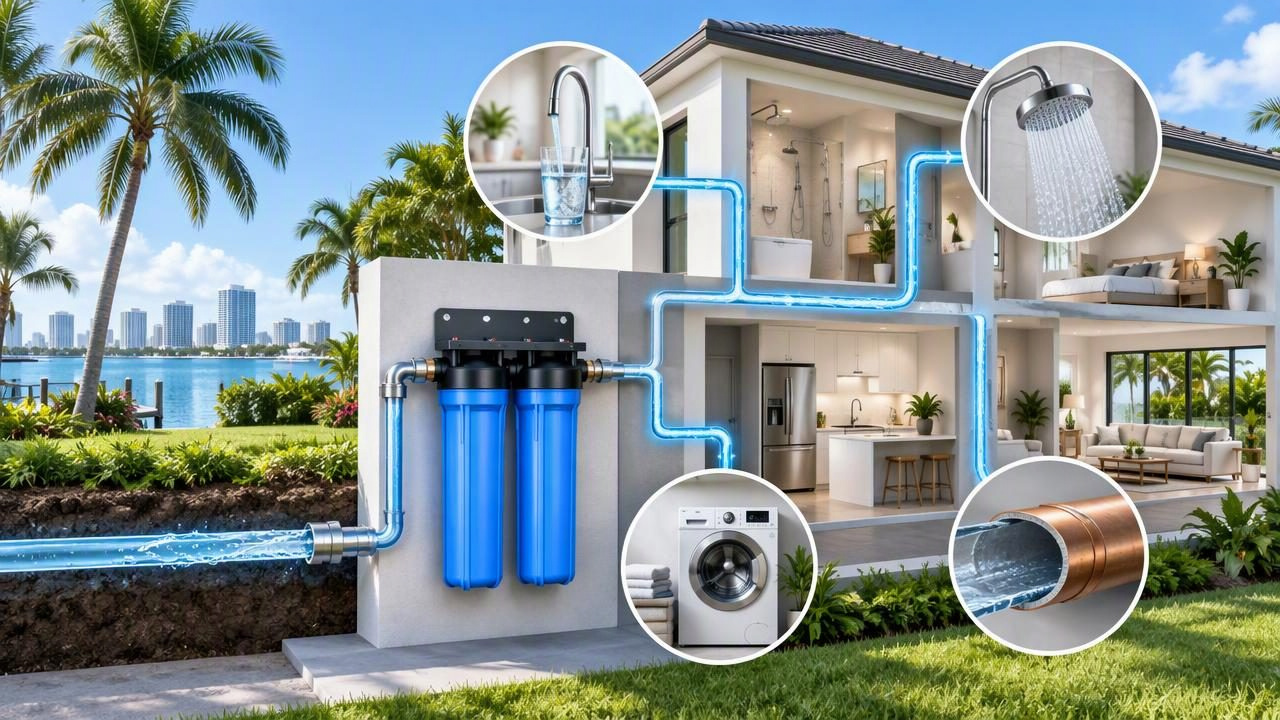
Water quality affects more than what comes out of the kitchen tap. It can influence showers, laundry, plumbing fixtures, and the lifespan of water-using appliances. A whole house water filter treats water as it enters your home, helping address selected water-quality concerns at multiple outlets—not just at one drinking-water faucet.
For South Florida homeowners, the right setup depends on the home’s water source and test results. Local water characteristics can vary, and a filter that works well for one concern may not address another. Understanding the benefits and limitations of whole house filtration can help you choose a system based on evidence rather than broad promises.
What Is a Whole House Water Filter?
A whole house filter, also called a point-of-entry system, is installed where the main water line enters a property. Water passes through the treatment equipment before traveling to showers, sinks, laundry machines, and other fixtures. This differs from a point-of-use filter, such as an under-sink reverse osmosis system, which treats water at a single tap.
Systems may use sediment filters, activated carbon, specialty media, or multiple stages. Each technology targets particular substances or properties. For example, sediment filtration can capture particles, while activated carbon can reduce chlorine and some compounds that affect taste and odor. No single filter removes every possible contaminant.
Key Whole House Water Filter Benefits
1. Treats water at multiple fixtures
Because treatment occurs at the point of entry, a properly selected system can improve water supplied throughout the home. That can be useful when a concern affects more than drinking water, such as chlorine odor noticeable in both the kitchen and shower. A whole house system is not a substitute for testing; it is a way to treat water based on identified needs.
2. Reduces chlorine taste and odor
Municipal water providers commonly use disinfectants to control germs as water travels through distribution systems. Some homeowners notice a chlorine taste or smell, particularly when filling a glass or taking a shower. An appropriately sized carbon filter may reduce chlorine and improve the sensory quality of water at multiple taps. Check the product’s certified performance claims, because filter media and contact time affect results.
3. Helps capture sediment and particles
Visible particles, grit, or sediment can affect water clarity and may collect in faucet aerators. A sediment prefilter can trap particles before water reaches household plumbing and equipment. This may be especially helpful for homes with a private well or a documented sediment issue. A filter cannot correct every cause of cloudy water, so persistent discoloration should be investigated and tested.
4. Can support plumbing and appliance care
Reducing sediment or certain corrosive substances may help limit unwanted deposits and exposure in plumbing, depending on the water chemistry and system design. That can benefit water heaters, washing machines, and fixtures. However, a standard whole house filter does not necessarily soften hard water. If mineral scale is the problem, a water softener or another treatment designed for hardness may be more appropriate.
5. Makes treated water available for everyday tasks
Some households prefer filtered water for cooking, bathing, and filling pet bowls—not only for drinking. A point-of-entry system can provide treatment at more locations without requiring a separate pitcher or faucet filter at each sink. Convenience is one of the practical whole house water filter benefits, but it depends on matching the treatment method to the concern.
6. Can reduce reliance on individual faucet filters
When a whole house system addresses a household-wide issue, it may simplify filtration compared with maintaining several separate devices. That does not automatically make it less expensive: installation, replacement cartridges, water use, and service all affect total cost. Compare the expected maintenance for the whole system with the cost and upkeep of point-of-use options.
What a Whole House Filter May Not Do
“Whole house” describes where water is treated, not how many contaminants the system removes. A basic sediment or carbon filter may not reduce lead, PFAS, dissolved salts, bacteria, or hardness. Some advanced systems are designed for specific targets, but performance depends on the exact model, certification, installation, and maintenance.
If the main concern is drinking-water contaminants such as lead or PFAS, review local water-quality information and arrange appropriate testing. Treatment may require a certified point-of-use filter, reverse osmosis, or another technology selected for the contaminant. For a private well, testing should reflect the well’s location and potential risks. Do not assume that clear, pleasant-tasting water is free of contaminants.
Important: Choose treatment based on test results and verified product claims—not on a general promise to “purify” all water.
Whole House Filter vs. Water Softener vs. Reverse Osmosis
| System | Typical role | Useful to know |
|---|---|---|
| Whole house filter | Treats selected concerns at the main water line | Media and performance vary; it may not remove hardness or dissolved contaminants. |
| Water softener | Reduces hardness minerals, commonly calcium and magnesium | Can help with scale, but does not serve as a general-purpose contaminant filter. |
| Reverse osmosis | Provides highly treated water at a dedicated drinking-water tap | Often used for dissolved substances; it does not treat every household outlet. |
These technologies can complement one another. For example, a home might use sediment and carbon filtration at the entry point, a softener for measured hardness, and reverse osmosis at the kitchen sink for drinking and cooking water. The right combination depends on test results, household priorities, and operating costs.
How to Choose a System for a South Florida Home
- Identify the water source. Find out whether the property receives municipal water or uses a private well. Review the local utility’s annual water-quality report where applicable.
- Test for the concern. Consider a qualified water test if you notice unusual taste, odor, staining, scale, or other changes. Testing can distinguish hardness from sediment or a contaminant concern.
- Match treatment to the result. Ask which specific substances the proposed system is designed to reduce and request supporting certification or performance documentation.
- Check flow and sizing. A system must be sized for household demand. Consider the number of bathrooms, simultaneous water use, pressure requirements, and the installer’s recommendations.
- Compare the full cost. Include equipment, installation, replacement media, service visits, and any wastewater or salt requirements—not just the initial price.
South Florida homes can have different water profiles, even within the same general area. Avoid choosing equipment solely because a neighbor has it or because a product is marketed for Florida. A current test and clear treatment goals are a more reliable starting point.
Maintenance Matters
Filters gradually collect particles or use up their treatment capacity. Follow the manufacturer’s replacement intervals, but also consider actual water use and incoming water quality. Some systems have pressure gauges or service indicators; a drop in flow can be a sign that inspection is needed, though it can have other causes.
- Replace cartridges and media on the schedule specified for the system.
- Keep a record of installation and service dates.
- Sanitize or flush equipment as directed by the manufacturer or qualified service provider.
- Retest water when the original issue returns or when your water source changes.
Skipping maintenance can reduce performance and, in some cases, allow trapped material to affect water quality or flow. Ask about ongoing service costs before purchasing so the system remains practical over time.
Are Whole House Water Filters Worth It?
A whole house system can be worthwhile when testing identifies a concern that affects water throughout the home, or when treating multiple outlets is a priority. It may be less suitable when the only goal is improving drinking water at one tap; a pitcher or under-sink system could be a simpler option. If hardness is the primary problem, a softener may be the more relevant solution.
The most useful whole house water filter benefits come from choosing a system that targets a real, measured need and keeping it properly maintained. Start with your water source, test for specific concerns, and compare treatment options before investing. For more South Florida water-quality guidance, Blog Water News shares practical information to help homeowners make informed choices.